by Rebekah Simon-Peter | Jan 18, 2016
The world wants more of churches: more spirituality, more community, more engagement, more love, more miracles, more demonstration of the kingdom. Not less. Yet, most of us are serving shrinking, declining, even dying churches. If our leadership is to be effective, if we are about manifesting the kingdom here on earth, if we are to make a true difference in the lives of those we lead, and the communities we serve, we need to think big. Then, even bigger.
Of course, thinking big isn’t enough. We have to know what to do with the ideas. Jesus mastered 3 hidden leadership skills that we would do well to learn.
To begin with, Jesus boldly crafted and expressed his vision. Even under the most difficult of circumstances.
Now when Jesus heard that John had been arrested, he withdrew to Galilee. He left Nazareth and made his home in Capernaum by the sea, in the territory of Zebulun and Naphtali, so that what had been spoken through the prophet Isaiah might be fulfilled:
Land of Zebulun, land of Naphtali,
on the road by the sea, across the Jordan, Galilee of the Gentiles–
the people who sat in darkness have seen a great light,
and for those who sat in the region and shadow of death
light has dawned.
From that time Jesus began to proclaim, “Repent for the kingdom of heaven has come near.”
In the shadow of John’s death, Jesus got to work. He went about the countryside proclaiming a message welcomed by some leaders of the time, and dangerous to other leaders. He didn’t let death or threats of death stop him. In fact, he was intent on being light in that particular time of darkness.
But he didn’t stop there. Or try to do it all himself. He found people who were aligned with his message.
As he walked by the Sea of Galilee, he saw two brothers, Simon, who is called Peter, and Andrew his brother, casting a net into the sea—for they were fishermen. And he said to them, “Follow me, and I will make you fish for people.” Immediately, they left their nets and followed him. As he went from there, he saw two other brothers, James son of Zebedee and his brother John, in the boat with their father Zebedee, mending their nets and he called them. Immediately, they left the boat and their father and followed him.
And that’s not all.
Jesus went throughout the Galilee, teaching in their synagogues and proclaiming the good news of the kingdom and curing every disease and every sickness among the people. So his fame spread throughout all Syria, and they brought to him all the sick, those who were afflicted with various diseases and pains, demoniacs, epileptics and paralytics, and he cured them. And great crowds followed him from Galilee, the Decapolis, Jerusalem, Judea and from beyond the Jordan.
Other Jewish teachers, rabbis and miracle workers traveled the land during Jesus’ day. What set him apart was that he was doing it as a sign of the inbreaking of the kingdom. In the process, he was building alignment for his vision. Crowds of people, great crowds, began to follow him. That’s when he taught them more about his vision.
Blessed are the poor in spirit, for theirs is the kingdom of heaven.
Blessed are those who mourn, for they will be comforted.
Blessed are the meek, for they will inherit the earth.
Blessed are those who hunger and thirst for righteousness, for they will be filled.
Blessed are the merciful, for they will receive mercy.
Blessed are the pure in heart, for they will see God.
Blessed are the peacemakers, for they will be called children of God.
Blessed are those who are persecuted for righteousness’ sake, for theirs it he Kingdom of Heaven.
Blessed are you when people revile you and persecute you and utter all kinds of evil against you falsely on my account. Rejoice and be glad, for your reward is great in heaven, for in the same way they persecuted the prophets who were before you.
Unlike some spiritual leaders today, Jesus wasn’t trying to do all the work himself. In fact, he knew that if the message ended with him, it would die when he did. He used the buy in of the people to execute his vision of the Kingdom.
Watch what he does with his disciples.
Then Jesus summoned his 12 disciples and gave them authority over unclean spirits, to cast them out, and to cure every disease and every sickness.
These 12 Jesus sent out with the following instructions, “Go nowhere among the Gentiles, and enter no town of the Samaritans, but go rather go to the lost sheep of the house of Israel. As you go, proclaim the good news, “The Kingdom of heaven has come near.” Cure the sick, raise the dead, cleanse the lepers, cast out demons.
Jesus doesn’t stop with this charge. He goes on to give them very specific instructions about how to execute the vision.
You received without payment; give without payment. Take no gold, or silver, or copper in your belts, no bag for your journey, or two tunics, or sandals, or a staff; for laborers deserve their food.
As specific as he is, he does not fall into micro-managing. He demonstrates trust in their ability to discern the nature of the people they will encounter.
Whatever town or village you enter, find out who in it is worthy, and stay there until you leave. As you enter the house, greet it. If the house is worthy, let your peace come upon it; but if it is not worthy, let your peace return to you. If anyone will not welcome you or listen to your words, shake off the dust from your feet as you leave that house or town. Truly I tell you, it will be more tolerable for the land of Sodom and Gomorrah on the day of judgment than for that town.
Vision. Alignment. Execution. These are the three hidden leadership skills Jesus practiced.
But leadership is not a linear process. It’s a spiral that redoubles and comes around again. Watch how Jesus demonstrates that.
Now when Jesus had finished instructing his 12 disciples, he went on from there to teach and proclaim his message in their cities.
He’s just sent off his 12 closest followers, and now he’s off to cast his vision, build alignment and empower execution among brand new people! Powerful visions are like that. They compel you, energize you, and pull you forward. This was not drudgery for Jesus. It was his passion and purpose in life. (Luke 4:43). It was the reason he got out of bed in the morning. He was unstoppable!
If leadership requires vision, alignment and execution, it seems to me that there is one criterion that precedes these three tasks.
The vision has to be worth it. It has to be big enough, bold enough, and compelling enough to promise a new state of affairs. Otherwise, you’ll lose interest. And so will everyone else.
Are you leading with a bold vision? That’s where it all starts.
by Rebekah Simon-Peter | Jan 11, 2016
I’ve been to a lot of church meetings where the drama has been over the top. Tempers rise unchecked. People stomp out of rooms. Or tensions simmer just beneath the surface and politeness masks deep division.
In fact, antics of the so-called drama queen is the stuff of many a coaching session and closed door meeting. But what if there was a kind of drama that energized people instead of drained them; that built up the church rather than tore it down?
That’s what I experienced as I entered the church sanctuary on Epiphany Sunday. I was transported into another time and place by the drama kings.
No, the drama kings were not guys having a meltdown. Rather, they were twenty-foot 
 tall puppets of the Magi festooned in regal, flowing clothing. Their movements were accompanied by drums and hand bells. They processed—one at a time—down the center aisle of the sanctuary while the rest of us looked on in wonder. It took 3 people who were hidden under folds of fabric to maneuver each Magi. Two people handled the poles that extended their arms and hands in greeting. A third person stabilized the inner pole that held the very large puppet upright.
After each Magi had processed to the front of the sanctuary, they bowed in greeting to one another in stately fashion. They were joined by a real-live young couple with a real-live baby, dressed up as Mary, Joseph, and Jesus. (This year baby Kate played Jesus.) The guiding star, suspended by a pole, also had a starring role. Camels made an appearance, as did some other minor characters.
This tableau of life-size and over-size characters became both the backdrop and the focal point of worship—from the call to worship, to the prayers, music and offering. Even as we passed the peace, people were invited to greet the Magi and the Holy Family. Their presence served as a creative reminder of the larger way these stories shape us.
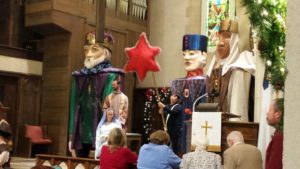 Yes, this pageant mixed up the story a bit—there is a manger and shepherds—but it gets the heart of the matter right: stories move us; visuals engage us; and the larger the story, the more apt we are to get swept up in it.
This particular church has been re-enacting this pageant for about 30 years. But that hasn’t lessened its impact. The puppets have received face lifts and fashion upgrades over the years. The players have changed; previous baby Jesus’ have matured into Marys and Josephs. One day they’ll be doting grandparents. Each annual staging of this drama draws in new community members and evokes fresh wonder in new congregants. The pageant is bigger than any single one of us; it draws us into a larger story by providing access to the Eternal.
Has your congregation employed the power of pageantry? If not, now is the time.
The season of Lent is a natural time to begin. From Ash Wednesday to Palm Sunday to foot washing or Passover Seders on Maundy Thursday, to Tenebrae Services on Good Friday, to Easter Sunday sunrise services, the opportunities for evocative ritual and passionate pageantry are rich indeed. But those options do not exhaust the possibilities.
Many Biblical stories lend themselves to the power of drama. Consider the Exodus from Egypt, the giving of the Law, Acts’ rendition of Pentecost, crossing the Jordan, the Baptism of Jesus, Mary and Elizabeth’s pregnancy stories, healing stories, or the feeding of the 5000. Don’t forget creative recitations of The Creation by James Weldon Johnson.
Of course, pageantry doesn’t have to be limited to Bible stories. As the popularity of the History Channel, bio-pics and re-enactors from the Civil War and Pioneer eras show, people love re-enacting key moments in history. Luther’s break with the Roman Catholic church, Wesley’s heart being strangely warmed, civil rights stories and the suffrage movement can put us in touch with the enduring values that make faith a living, breathing experience.
If worship has grown stale in your church, try something altogether new and ancient at the same  time: pageantry. Whether reader’s theater, poetry or puppetry, these art forms tap into a spiritual realm that both enlivens and inspires.
There was a time when the church specialized in culture and not culture wars. When it inspired great works of art—from Leonard Bernstein’s Mass to Handel’s Messiah to Michelangelo’s Sistine Chapel, David and the Pieta. Those days do not have to be over. Move over drama queens; it’s time for drama kings to take center stage.
by Rebekah Simon-Peter | Dec 14, 2015
Good news is emerging from Paris, even as the City of Light continues to clear away wreckage from recent deadly terror attacks. In a Parisian suburb, top leaders from around the globe—faith-based and heads of state, poor and rich, small and large, developing and industrialized—gathered for 13 days to hammer out a climate accord hopeful enough for heaven and nature to sing. And for churches to celebrate.
The Paris Accord represents what many thought impossible. In an unprecedented show of collaboration, 195 countries came together to take shared responsibility to slow global temperature rise and the havoc that results from it. As you probably know, global warming has already begun disrupting the delicate balances of Creation. Weather patterns are shifting dramatically, sea levels are rising forcing some communities to move to higher ground, and people are being displaced. In fact, the horrifying civil war in Syria has been linked to drought spurred by climate change.
Why is this good news for churches?
We who take to heart the Gospel message to assist the poor and dispossessed finally have some help. Even as we make flood buckets, organize work trips to clean up after natural disasters, send money and love and prayers to those in need, cook endless meals for the hungry, and, pray for the needs of the world, our efforts now have some muscular international assistance. Instead of just reacting to the consequences of climate change the world has come together to deal with its causes. This shift from reaction to action is a welcome one for the Creation.
In addition, religious voices from Pope Francis to Episcopal Priest Sally Bingham of Interfaith Power and Light to Peter Sawtell of Eco-Justice Ministries have long been calling climate change what it is: a humanitarian disaster and moral imperative.
There’s more to do.
Our voices are needed in the process of staying the course. The Paris Accords are an impressive beginning. However, they don’t actually go far enough to stop the devastation.
What can your church do?
Continue to comfort the afflicted. At the same time, don’t be afraid to afflict the comfortable. That means calling on local, national and international leaders to make good on their commitments, for the sake of all Creation.
Pray for the ongoing health of Creation and her creatures.
Open your hearts and doors to assist people who lose their jobs as fossil fuel production is phased out. Also be prepared to assist people displaced by natural disasters, war and conflicts over diminishing natural resources—including international refugees.
Cultivate wonder for the Creation. Host camps, weekend retreats in nature, and outdoor Vacation Bible School experiences.
Preach on the care of Creation, sustainability, compassion and justice—for all God’s Creation.
Green your buildings, ministries, and worship services.
Educate yourselves. It is now documented that the “debate” on climate science has been manufactured by fossil fuel industries to cast doubt on legitimate climate science.
Continue to call on ourselves, God, and the powers that be to place the common good before all else.
Cultivate resilience.
Resilience is the name of the game in a changing climate. Empowering the poor, welcoming the stranger, and loving our enemies builds emotional and spiritual resilience. Planting community gardens, partnering with community organizations, and befriending our neighbors builds communal resilience.
Don’t give in to the kind of fear-mongering and isolationism that divides us. We will rise or fall together. Instead, let love be our highest ideal, and the common good of all Creation, our goal. That’s cause for all heaven and nature to sing.
by Rebekah Simon-Peter | Dec 7, 2015
We live in a new (ab)normal with mass shootings almost every day of the week. As of this writing, there was shooting in London today, a few days ago San Bernardino, before that Paris, Planned Parenthood, and Minneapolis. And that’s just the big headlines from the last 10 days. There will probably be more by the time you get this.
What’s a church, or synagogue or mosque to do? As Jonathan Merritt points out, prayer alone isn’t enough. Even the New York Daily News is clear on this: “God Isn’t Fixing This.” I’d like to suggest 4 things every Christian, Jewish and Muslim religious leader can do. And 1 thing none of us should do.
Call us to care. With so much violence in the world, it’s easy to go numb. How many times can we memorize the names of those who died, grieve the lives they left behind, or send money to help re-build shattered communities? After 9/11—with Oklahoma City, Columbine and Waco already behind us—many of us already hit compassion fatigue. Then came Hurricane Katrina followed by an ever increasing number of natural disasters. Here’s the danger of succumbing to numb: not caring dims our humanity, disconnects us from our neighbors, deadens us to our own vulnerability, denies hard realities of the world, and diminishes our sense of personal agency.
Pastors, priests, imams, rabbis, ministers, and congregational leaders, please: call us to care. Last week I attended a deeply touching, beautifully executed, interfaith prayer service for peace that was surprisingly sophisticated for my Wyoming city. Hosted in a Roman Catholic church, it included men, women, gay, straight, Christian, Muslim, and Jewish—with just about every hue of humanity represented. No one wanted to leave when it was over.
Call us to stay calm. In the wake of tragedy, there’s a lot of pressure to have an immediate response, which often leads to unwise pronouncements and unjust actions. Religious leaders tasked with helping make sense of the world around us should proceed with caution. A few days after 9/11, Pat Robertson and Jerry Falwell Sr. prognosticated to the world that pagans, abortionists, feminists, gays, and lesbians “helped this to happen.” Pastor John Hagee linked Hurricane Katrina to a gay pride event. No mention was even made of missing or defective levees, let alone climate change. Similarly, in a recent speech, Falwell Jr. reactively encouraged students at Christian Liberty University to be armed and “end those Muslims.” No mention was made of love, forgiveness, and healing of Christ. Make no mistake, comments like these only serve to inspire reactionary violence against innocent people.
I remember how tough it was to speak intelligibly on the Sunday after 9/11. My advice to you? When it doubt, adopt a pastoral approach. Remind us that God is with us, that we have seen tough times before, that we can rely on God for guidance. Then design ways for us to do that. In the congregation I led, we embarked on a study of just war as a way of engaging our minds and hearts. “We don’t really know why this happened” or “We’re discerning an appropriate response” or “I’m not sure I know what to think,” are also perfectly reasonable things to say early on.
Call us to action. To avoid succumbing to numb, we have to do something. Other than round up or kill people we are afraid of, that is. Our respective faiths give us plenty to work with. This is the time to practice the best tenets of our faith, not react in fear. Now is the time to love our neighbors, work for peace, intercede in prayer, practice compassion, welcome the stranger, house vulnerable refugees, protect the innocent, nurture the hurting, and yes, love our enemies. Above all, this is the time to imitate a loving, compassionate, beneficent and just God. The more we do these things, the safer and more connected we will be.
Call out the Lies. ISIS, the KKK, and other religious extremist groups rely on twisting sacred scriptures, tradition, interpretation and facts to make their cases. It’s up to us who know better to correct the lies. Muslim scholars and leaders have been doing just this. Christian and Jewish leaders too need to call out their peers who justify targeting Muslims, blaming refugees, and shutting borders—based on the Bible. Otherwise, we become mirror images of the hateful, xenophobic violence we say we stand against.
Finally, here’s one “please don’t do.”
Please don’t pretend soul-shaking acts of violence aren’t happening. People watch the news. They listen to the radio. They scan Facebook and Twitter feeds. They know what’s happening in the world. Even if it means changing your service last minute, at the very least lift up these events in prayer. To stay silent is to be rendered irrelevant. That’s a new kind of (ab)normal we should we resist at every turn.
by Rebekah Simon-Peter | Nov 23, 2015
The number one thing I hear church leaders around the country say is: We’d like to have more young people in worship. That’s a terrific aspiration. But don’t say it if you don’t mean it. Digitals (born around 1999 and onward) and Millennials (born around 1982-1998) will bring their own set of experiences, expectations, hopes, and dreams to church. Which may or may not match yours. How willing you are to accept them on their own terms is a sign of your true readiness.
Here’s a 10-point check list, with a bonus 11th point, to help you know if you are truly ready for young people. Or just wish you were.
You Know You’re Ready for Young People if…
- You have an online presence. In 1999, when I arrived at the Wyoming church I served, it was my job to pull them into the late 20th century just as we crossed over into the 21st century. That meant getting an answering machine, updating the copy machine, getting a working computer and setting up an email address. Eventually it included launching a website and installing screens and projectors. Today, getting the church up to speed means all of that plus a Facebook page, a Twitter account, perhaps other social media, and keeping it all updated. An online presence is another way of saying we care about you, and we want you to know about us. It also says we have some stuff going on that is worth talking about.
- You spend as much time being the church as going to church. Churches on the downward slope of decline focus a great deal of their time on maintaining the structures of the congregation. They spend a lot less time focused on enacting the Gospel through new ministries and new relationships. In other words, the primary activities of churches in decline are more about going to church than being the church. Younger people are more likely to be interested in churches that show they can make a real difference in the world rather than in churches that are just in survival mode.
- You’re willing to engage real issues in the world. Jesus restored people to independent living, fed hungry people, gave hope to persecuted people, healed those who were ill, helped the clueless see the error of their ways, and reached across divides to connect with people of different ethnic and religious backgrounds. What is your church doing along these lines? While the political process can positively or negatively impact people dealing with these issues, don’t tell young people how to vote. Rather, show them that people who face these issues are being helped by the church.
- You’re willing to deviate from 3 hymns and a sermon. Surprisingly enough, most young people don’t necessarily need a praise bands and an “easy” or non-existent liturgy. What they do need is worship that’s meaningful and that helps them experience God. Make use of ritual, nuanced liturgy, testimony, lectio divina, lighting of candles, communion, visuals, special offerings, high quality music, and a variety of prayer styles to fully communicate the power of the Gospel. This will not only touch the under 33 crowd, but older folks as well.
- Smart phones are welcome in church. People use their phones for all kinds of things: consulting an uploaded Bible or commentary, searching out a resource mentioned in worship, snapping a picture of something post-worthy, texting in a prayer request, or sending a friend a hopeful nugget they just heard. Smart phones are here to stay. Used rightly, they can definitely enhance worship by keeping people engaged. It’s also perfectly okay to ask people to mute them or put them on vibrate before worship begins.
- You focus on the “brilliant future God has for us.” This, in the words of Jeremy Steele, is a lot more attractive than harping on the sinfulness of humanity. Frankly, it may be more biblical too. If Jesus did inaugurate the Kingdom of Heaven, if his life, death and resurrection did change the world forever, if our prayers do matter, if worship does change us, then doesn’t it make sense that we are living into God’s brilliant future even now? Why not celebrate that? Worship shouldn’t be a recounting of the nightly news, but a re-telling of the Good News for our day and time.
- You’re willing to have beliefs questioned. Young people are willing to engage, question, consider, reject and even re-consider beliefs. That sort of intellectual honesty should not be a turn off for the church, but rather a chance to re-imagine or re-claim your own faith, and traditions. Engage young people in honest conversations and open discussions. Be prepared for your faith, and theirs, to grow as a result. Not to mention some discomfort.
- Your leadership reflects generational and racial diversity. Ethnic and racial groups are reaching a plurality in the US. That means there are as many black, brown, beige, and tan complected people in the US as there are pink ones. At the same time, there are more millennials than boomers. Bottom line: the face of America, and the world, is changing. How about in your church? Wherever possible, let your leadership reflect this diversity. If not in full time or paid staff, then in volunteer staff or in lay leadership.
- Love is a reality not a slogan. You may say you have open hearts, open minds, and open doors. But it
 needs to be a reality in your church, not just words. You can start by praying on a regular basis for people who are very different from you. Let these prayers open your hearts. You’ll know you’re there when a transgendered, gay, ethnic, disabled, street person, refugee, or person from another country or with a different accent is welcomed as warmly as someone who looks or seems just like you. Young people are watching.
10. You’re willing for things to get a little messy. If you’re willing to do some or all of the above then you’ve noticed that things are probably a little messy. Life is unpredictable when we open up to accommodate people who are different than we are. The unexpected can and does happen. Consider this the beginning of unpredictability, and not the end of it.
I am throwing in a bonus to the checklist. Here it is, #11. It may be the most important one of all.
11. You have a vision bigger than “attract young people to church.” One lay led church I am working with is in the process of shifting their vision from growing a strong youth group to engaging young people in serving their neighbors. In their first vision, the young people are the objects of mission. In the second vision, the young people are seen as capable change agents who can impact their own world for the better. That’s a very different focus. One that’s a lot more energizing for both the adults and the young people.
So, how’d you do? If you answered 8-10 with a yes then feel very confident that you have a place that young people will feel welcome. Ask, invite and engage the 33 and under crowd eagerly and joyfully. Be ready to continue to grow and change.
If you answered 5-7 with a yes, you are probably headed in the right direction. But you still have some significant work to do. The good news is that doing this work will make your church stronger in many ways. Not just for extending an authentic welcome to younger people, but to truly be the church. Have an open discussion with the leaders in the congregation. Ask yourselves, what additional steps can we take to move toward a 10? Then do them.
If you answer 1-4 with a yes, ask yourself why you want to have young people in the church. If it’s just to keep the church from shutting down, it’s time to get more imaginative. Spend time in prayer, asking God to show you the Divine will for your building, your resources, and your legacy. Ask God if there’s anything you need to let go in order for these things to come to pass. Then be willing to do those things.
Here’s the bottom line: young people want more from the church, not less. This is an opportunity to flex our own faith muscles, showing the world all the church can be. Not merely a silent witness but an active participant. Not simply a throwback to an earlier time but a sacred gathering of people who live as if their faith truly matters—to the world.
by Rebekah Simon-Peter | Nov 3, 2015
Money gets a bad rap in some churches. The thinking goes something like this: Even though we ask for money every time we collect an offering, the truth is, we shouldn’t need it; we shouldn’t want it; we should be able to get by without it, just like Jesus did. After all, money is the root of all evil. We talk about money too much as it is, especially given that Jesus threw the money changers out of the Temple. That meant he was calling for a separation of church and plate. And his preference for the widowed woman who put 2 coins into the Temple Treasury over the rich folks who gave a lot more means it’s better to get by on less. Right?
Wrong.
To start with, this kind of thinking isn’t very helpful. First off, it puts us at odds with Jesus’ own life. Secondly, it doesn’t square with what the Bible actually says. Third, it doesn’t reflect good Biblical scholarship. And fourth, it misses the point!
Read on to see the upside of money and churches. And what your church can do to develop a better relationship with it.
Let’s start by looking at Jesus’ own life. First off, Jesus was a tradesman. He was a working man who made an income and used money. His saying, “Give to Caesar what is Caesar’s and to God what is God’s” suggests he tithed and paid taxes like other Jews of his day. When he began to travel widely and teach, with a bevvy of disciples in tow, he began to rely on his network of supporters, many of them women. That means his supporters used their monies to support him. In this case, money was the root of tremendous good.
Secondly, nowhere in scripture does it say money is the root of all evil. Here’s how the NIV translates 1 Timothy 6:10: “For the love of money is a root of all kinds of evil.” It goes on to say “Some people, eager for money, have
wandered from the faith and pierced themselves with many griefs.” The truth is people wander from the faith for lots of reasons. Love of money is one of them. But any obsession can be a stand in for God—whether we’re talking shoes, sex, a perfectly shaped body, power, or even too many cats or dogs! This passage is hardly a wholesale condemnation of money. The truth is, we need money to live. And the church needs money to survive and thrive, and to do good in the world.
On to the next passage. Recent New Testament scholarship shines additional light on the money changers passage which appears in all four Gospels. It’s not that money or money changers were forbidden in the Temple. Offering sacrifices was an important part of Second Temple Worship. Rather than haul sacrificial animals with them long distances, though, pilgrims brought their local monies with them, changed it into the coinage used in the Temple, purchased animals for sacrifice, and made their sacrifices to God. It’s thought that what enraged Jesus was not the existence of the tables, but their placement; they were located in the wrong part of the Temple—the Court of the Gentiles. This may have prevented their ability to worship God fully. If money is getting in the way of the church’s relationship with God, that’s a problem. If it supports and nurtures the church’s ability to cultivate godly relationships, that’s not a problem. That’s a blessing.
Finally, we know Jesus didn’t call for a separation of church and plate because of how he approved of the widowed woman putting her meager coins into the Temple Treasury. Rather than this being a sign that we should get by on less, he commended that she gave all she had. Proportionally, she gave much more than the well to do. This is not a condemnation of wealth, but of lack of sacrificial giving. Wesley called us to this when he counseled, “Earn all you can, save all you can and give all you can.”
In visiting with churches, I encounter many faithful people who suffer greatly over the perceived disconnect between needing money and the challenge of asking for it while at the same time being afraid of it, lest they violate the Bible’s teachings. My perception is this: money is a neutral tool that expresses our values. In the hands of a visionary, compassionate and faithful church, money can be the source of tremendous good.

