Forty Days of Apostleship: Believe Your Life Has Purpose

Forty Days of Apostleship: Believe Your Life Has Purpose

The world has altered dramatically since Ash Wednesday and the launch of this Forty Days of Apostleship. The rapid spread of this current scourge has changed everything—restricting or shutting down many public spaces, including churches.

Now that Christians have effectively been kicked out of the nest, church doors clanging shut behind them, it’s time for you and your people to take on the mantle of the apostle you are! No more hiding behind the safety of numbers in worship or the protection of the pews. Your people were thrust out into the world. It’s a scary place to be!

That means people are looking to you to continue to teach them. This is your moment. They need you, and they know they need you. There will be no assurance from the news or the government. They will be looking to their faith.

You can give them the deep connection they are longing for by empowering them to believe like Jesus. That’s the mark of an apostle.

Jesus Believed in His Purpose

What did Jesus believe? In his divine partnership with God, he believed that his prayers had power and that he had superpowers. Most importantly, Jesus believed his life had a purpose.

And Jesus handed that purpose to you. Your job is to embrace the belief that he had. And to share it with others. So how do you believe like Jesus, and how does that lead to action? Use the following process to deepen your faith and that of the people you lead.

Jesus believed his life had purpose and he handed that purpose to you. Your job is to embrace the belief he had and share it with others. Share on X

Soulful Steps: Jesus’ Four-Part Process

Jesus’ life reveals a four-part process of identifying purpose in the Gospels. Take, for example, this story of healing in Luke 4:40-44.

At sunset, the people brought to Jesus all who had various kinds of sickness and laying his hands on each one, and he healed them. Moreover, demons came out of many people, shouting, “You are the Son of God!” But he rebuked them and would not allow them to speak because they knew he was the Messiah. At daybreak, Jesus went out to a solitary place. The people were looking for him, and when they came to where he was, they tried to keep him from leaving them. But he said, “I must proclaim the good news of the kingdom of God to the other towns because that is why I was sent.” And he kept on preaching in the synagogues of Judea.”

You can see the four-part process and how it connects you with Jesus and the purpose of this story.

Part One—Doing What You Love

What deeply engages you, comes easily, is natural for you, and serves the greater good? That’s (at least one of) your purpose (s). In this story, Jesus was laying hands on people who were sick and ailing—physically and spiritually. He healed them and cast out demons that were tormenting them.

Part Two—Challenges Arise

Something contrary to your purpose happens. Identify what pulls you off course or causes you to settle for a lesser good. In Jesus’ life, the people he had healed came back to beg him to stay with them. Understandably, they didn’t want him to go.

Part Three—Clarity Emerges

Contrary or challenging conditions make you get clear on your purpose. In this Gospel story, Jesus answers the people, “I must proclaim the good news of the kingdom of God to the other towns also because that is why I was sent.” In other words,—No can do. I have other places to go and people to heal.

Part Four—Clarity Leads to Action

This chain of events makes the way clear for you to take action. We see it in Jesus’ life: “He kept on preaching in the synagogues of Judea.”

Embrace the Belief that Your Life Has Purpose

To embrace the belief that your life has a purpose, personalize the process by writing out these steps:

First, write out the things that come naturally and easily to you and serve a greater good.

Second, write out situations that have arisen contrary to the things you noted in step one.

Third, note what you have found yourself saying or thinking that points you back to your purpose.

Fourth, write what actions you have taken or can take that align with your life’s purpose.

Apostolic Action

Get into action! Say YES! to requests, needs, and circumstances that are consistent with your life’s purpose, or create the conditions in which the world needs your gifts.

But don’t worry if you are not crystal clear on your purpose. I remember when I was agonizing over my call. Everyone else seemed to know what they were doing, but I didn’t. One day it occurred to me that my gifts were my path. God would not have called me to a path that I wasn’t prepared for. Just as Jesus’ purpose is in his gifts, your purpose will be too.

If all else fails, act as though you do have a purpose. And that what you are currently involved in reveals some aspect of your purposeful life. “All things work for the good of those who love the Lord and are called to God’s purpose.”

Don’t Let The Scourge Discourage You.

Above all, don’t let the scourge discourage you! You are not alone!
Two Popes, Three Opinions

Two Popes, Three Opinions

There’s a classic Jewish aphorism: “two Jews, three opinions.”  It sounds like the punch line to a joke, but it’s merely an observation about Jewish willingness to see all sides of an argument and to debate them with aplomb. Rabbi Wolpe references Yeats: “Out of the quarrel with others we make rhetoric; out of the quarrel with ourselves we make poetry” as he lovingly notes the Jewish penchant for argument as holy discernment.

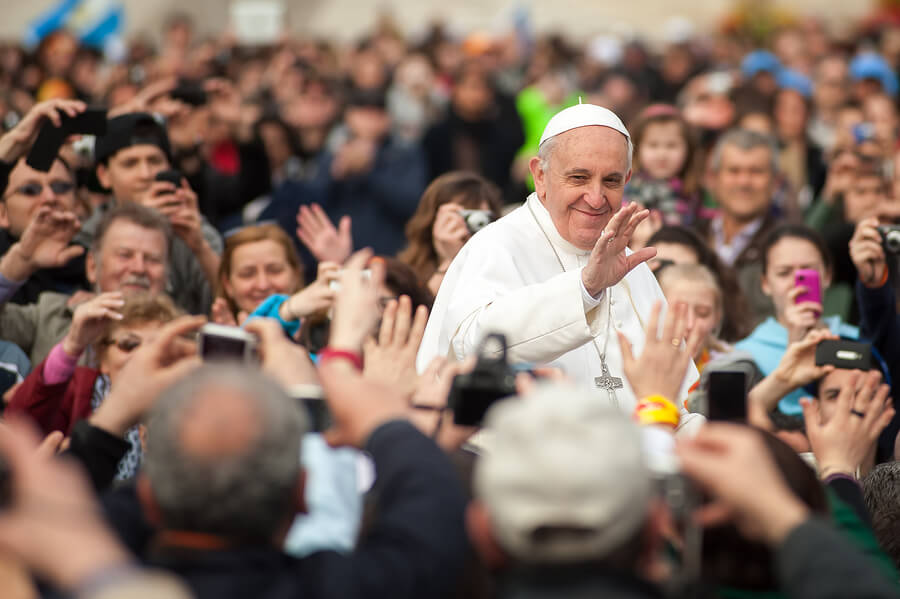
One wonders with the two Popes—the active Pope Francis and the retired Pope Benedict—if  what is being produced in their quarrel is rhetoric or poetry.

While both Popes are, of course, Catholic, they come from very different streams of Catholicism.  That difference was made clear in the recent Netflix movie The Two Popes. The flick followed the unusual transition of power between the conservative Benedict and the liberal Francis.  It juxtaposed the European cardinal—a man of the Vatican’s inner court, and the South American Jesuit—a man of the people. Along the way it showed the two popes coming to terms with each other’s worldviews through mutual confession and bearing of one another’s burdens.

I have been hungry for models of leadership which transcend dismissive politics (I define dismissive politics as anything that labels the opposite point of view with words such as “hoax,” “witch hunt” or “fake”). This movie satisfied my hunger.

I found The Two Popes to be particularly appealing because it zeroes in on the story of an unlikely leadership transition between two very different personalities.  In 2005 Pope Benedict had campaigned for and welcomed the papacy, while Cardinal Bergoglio had shied away from it.  Benedict was elected but eight years in, he has burned out under the pressures, including the burgeoning crisis of priestly pedophilia.  He is ready to leave.  At the same time, Bergoglio is ready to retire. In order to have his retirement received, though, he must travel to Rome to meet with Benedict.

Yet Benedict holds him off, parries with him for days, and refuses to accept his retirement.  As the two men become increasingly transparent one another, first tentatively, then unequivocally, ­­­­­something unlikely happens.  The two men come to trust one another, to understand one another.  Maybe even befriend one another. When Bergoglio is elected pope, the other beams.  “I must back away.  Your time has come.”

Sources report that this type of interaction may not in fact have occurred.  Yet it speaks to the kind of leadership that many of us long for—transparent, transformative, responsive to the needs of the people, and responsive to the soul within.

At the same time as this movie has come out, a verifiable interaction between the two popes has occurred.  While Pope Francis is exploring ordaining married men in remote areas of the Amazon, a new book lauding celibacy for priests bears Pope Benedict’s name as co-author. At first glance, this seems to be in direct contrast with the unexpected quality of leadership Benedict demonstrates in the movie. In the movie he promises not to undermine Francis.  In real life, through this book, he seems to be.  But a closer look at the facts reveals something else.  Since the book’s release, Benedict has protested that he did not authorize his name to be used as a co-author.  He has ordered his name be taken off it.

In the meantime, the rest of the world has glimpsed the kind of debate that allows for new opinions and new vistas to arise. While Catholics wonder if two popes and at least two opinions are good for the unity of the church, there may be an upside. A diversity of opinions may actually get people talking, exchanging perspectives, and searching for deeper truths.  As United Methodists, who have been confronted with either/or schism know, that kind of exploration has to be good for the church.

If you would like to learn how to embody a new model of leadership for your church, please contact us or visit www.cultureofrenewal.com to learn how to dream and lead like Jesus.

Three Ways to Be Light in the Darkness

Three Ways to Be Light in the Darkness

It’s easy to get depressed these days. Between the pandemic, meanspirited win/lose politics, the dismissal of fact-based debate, racial and social issues, public shootings, brutal treatment of migrants and asylum seekers, extreme weather events, and destabilized foreign relations, the darkness around us seems to be deepening. Fear is its constant companion.

The darker things get, the more afraid you may become to speak out, to venture truth, to stand for justice or mercy. Yet it is exactly at this time that your light matters the most.

But how do you shine when all the evidence around you says to give up or to dim your flame? Or worse, when the evidence seems to be that your light makes no difference?

I want to share with you three ways to be light in the darkness—to increase the brightness in a time of widespread doom and gloom, without also increasing the darkness.

Consider the nature of light. Jesus and other wisdom teachers tell us that light is the manifestation of love, wisdom, and truth. The sciences tell us that light waves carry information, thus intelligence. Both Biblical authors and modern-day ecologists tell us that light is the basis of all life.

Given, then, that you are stewards of this love, wisdom and truth; this information and intelligence; this life-giving energy, what kind of action can you take to increase the light and diminish the darkness?

First, befriend the love that resides deep in your soul. You know who you are.  You know what you believe in, what you stand for. Take comfort in this inner knowing.  Visit this place within often so that you do not lose your way in larger spheres of chaos.  As you become a frequent visitor to inner vaults of peace and wisdom, you will radiate soul-energy into the world.  As you shine this light into the world, you replenish the world’s depleted storehouses.

My dad is able to buoy the spirits of my mom, who lives with the debilitating disease of ALS, because he taps deeply into this reservoir, and shares it freely with her. She does likewise. Even though she cannot speak or move, their home is a place of surprising joy.

Second, speak truth and wisdom out loud.  Let it pierce the deceit and vagueness within which evil thrives.  Truth is a brightly glowing torch. It carries a very high spiritual vibration.  When you speak, your words reverberate far beyond your knowing, offering hope, instilling strength. Take care, though, that you do not also increase the darkness by coupling your words with blame, judgement, or contempt.

Jesus reminds us to judge not lest we ourselves be judged. What does he mean? The simple meaning is that others may counter your truth and your judgment with their own.  At a more subtle level, the energies your speech carry not only penetrate those around you, but they ripple back into your own life.  Take care the energies with which you speak.

Third, lift up the values and ethics over politics. Political expediency is about getting and maintaining power over others at all costs.  It’s about winners and losers. In the game of politics, the ends justify the means. Not so with ethics. Here the means matter greatly for it is in the wise use of power that social capital is accrued. How people are treated, how the earth is stewarded, how the vulnerable are shielded from harm matters every bit as much as any final result.

One pastor friend lamented the win/lose nature of the impeachment proceedings, and the hard divides it reveals.  “It’s the same in our churches when it comes to human sexuality. We are saying the same thing as the Senate and the Congress.  ‘If your facts and perspective don’t agree with mine, then I can simply dismiss you.’ How can we ever be united like this?  Who is going to lead us?”

You will. Not by focusing on politics, but by shifting the conversation to ethics. Ethics, grounded in the Gospel of the Kingdom of God, do not take up residence in any political party. Instead, they are anchored in the life of the Spirit.  They are the unmistakable good that the heart knows, and the Gospel bears witness to.

Several months ago, I attended a retreat hosted by the HeartMath Institute. This scientific research organization studies the connection between the emotional and physical properties of the heart.  They found that radiating emotions like compassion, care, forgiveness and gratitude have a positive impact on surrounding people. Beyond that, these particular emotions raise the electromagnetic vibration of the planet as a whole. This higher vibration, in turn, creates a growing reservoir of well-being which positively impacts the entire creation.  The higher the vibration, the more the light it radiates.

As you prepare to lead your congregations and chart paths for the future, be good stewards of the light you bear. Abide in the deep love, wisdom and truth of your soul. Communicate information and intelligence. Intentionally lift up ethical values that increase light and life. Do not give in to fear.

Learn more about how to lead from bigger perspectives and more daring dreams.

Living Epiphany

Living Epiphany

The Season of Epiphany is framed by two key events in the life of Christ:  his baptism and his transfiguration.  In between these two major experiences, this liturgical season covers Jesus’ entire life and ministry.  It’s a season of deepening in spiritual growth.

There’s an interesting element, though, in the Season of Epiphany.  A hidden message contained in these passages.  One that will likely surprise you.

Just as the Season of Epiphany explores and celebrates how God incarnates in the life and ministry of Jesus, so it invites you to explore and celebrate the presence of God within your own life and ministry.   What do I mean by that?  Just this: if you have a body, then you have a soul.  If you have a soul, then you have a slice of the living Divine presence within you.  As a follower of Jesus, you are called to be Christ-like in every way.  That means you also harbor twin natures or impulses—both human and divine.  To walk in the footsteps of Jesus is to cultivate the full expression of both your humanity and your divinity.

This Epiphany, do listen to the promptings of the Spirit within you.  With Jesus as your Guide, ask:

  • What is God eager to express through me?
  • How is God fulfilling divine longings through my life and ministry?
  • How is God working through me to contribute to the Kingdom?

There are needs all around you:  in your family, in the congregation, in the community, in the denomination, in the country, and in the world.  Enough that it just might feel overwhelming.  Consider this:  overwhelm is the sensation that comes when you try to control outcomes, or resist the movement of the Spirit.  Yet, you are divinely designed to be a co-creator with God. May you live into this epiphany, this revelation.  And may this Season of Epiphany be a time of surprising, divinely guided growth for you.

Not sure how to live into the fullness of these promptings?  Join us for the DARE to Dream Like Jesus online workshop, beginning January 14, 2020.

Machetes, Guns and the Hidden Message of Epiphany

Machetes, Guns and the Hidden Message of Epiphany

When a machete-bearing assailant broke into a private Hasidic home to “get” the Jews who were celebrating Chanukah there, his move was both horrific and ironic.  That the safety and merriment of a home could be violated by such hate is unthinkable. That it happened at Chanukah is incongruous.  Chanukah is at its core a holiday of religious freedom whose eight nights of light commemorate Jews’ ability to worship God in their own way—free and unfettered.  This terrorist served to heighten the awareness of our need for Chanukah.

In the Jewish pantheon of holidays, the Festival of Lights is relatively minor.  Yet it has taken on even greater importance in a Christmas-centric culture.  In light of this year’s increasing number of anti-Semitic incidents, it is sure to take on even greater significance.

When an armed assailant drew a gun at West Freeway Church and shot down two people on the Sunday after Christmas, his move was also horrific and ironic.  That the safety of sacred worship might be interrupted by gunfire is reprehensible.  That it took place directly after Communion is absurd. His violence reinforced our need of the Gospel, of the Kingdom.

Both acts of violence meant to snuff out something: a sense of belonging, safety, connection.  Undoubtedly, lives are forever shattered.  At the same time, something equally sacred, equally unshakable, is also taking hold.

Instead of highlighting the “otherness” of the victims, these horrific acts reinforced a further irony:  the inhumanity of the perpetrators. Their destructive, life-denying actions do not mirror who we strive to be.

The forces of darkness these men harnessed are the very ones that Advent laments and which Epiphany fully addresses. Rise of Skywalker (the latest Star Wars movie—which I swore I wouldn’t see but am ever so glad I did) shows the value of focused and intentional resistance to the forces of darkness.  Victory comes not from matching outrage with outrage, but by matching the calculated and cunning desire for power with a focused insistence on using The Force and its light. Rise of Skywalker showed that even the strongest proponents of light have seeds of darkness within them, and even the strongest proponents of evil can break free of its grip.

This Epiphany, we celebrate the Incarnation.  This ancient holiday celebrates that even in the midst of machetes, guns, and hate–God breaks through into our human experience.  All that is good and holy and divine are borne in the life, body, and witness of Jesus of Nazareth.

This year, Epiphany has a deeper, more surprising message for us. Just as God breaks through into human experience through Jesus, so too through us.  Made in the image of God, called to be Christ-like in every way, we too are designed to bear both humanity and divinity. To have a body is to have a soul.  To have a soul is to bear the incarnation of God, to be a hidden slice of the divine.

In the face of increasing public violence, and the inhumanity it reveals—it’s common to respond with either seething outrage or frozen immobilization.  I get it.  I have felt both.  I’m just not sure either of those ways moves us sustainably toward the kingdom.

But there is a third way.  It comes by tapping into the promise of Epiphany.  Together with Jesus, following his lead and direction, we can tap into our inner divinity.  We can dare to co-create miracles with God.  We can transform seething outrage into focused action and let frozen immobilization melt into collaboration and community.

I invite you to bring your Epiphany dreams for a new decade to our January course:  DARE to Dream Like Jesus.  Let your dreams take hold as you explore your authority, your agency and your ability to bring the impossible to life. Click here for more information.


Christmas and the Last-Minute Leader

Christmas and the Last-Minute Leader

If you are a last-minute leader, you’re not alone.  You’re not the only one putting finishing touches on a worship service, sermon, play, piece of music, bulletin or outreach effort.  In fact, you can be forgiven for thinking your timing is right in line with the theme of the season.  With no room at the inn, Mary and Joseph are ill-prepared for Mary to comfortably give birth to Jesus.  Much of Jesus’ early life, too, is spent on the fly avoiding Herod.

As Biblical as being last-minute maybe, there’s a cost for today’s church leader. We are in danger of missing the very spiritual qualities we are preparing to share with others.

Last-minute activity, done under pressure, activates the release of adrenaline. Once adrenaline is released, it gives us a heart-pounding rush, energizing the system. There’s a feel-good component to that. At the same time, it shuts down the part of the brain that is tuned in to the mood. And it messes with the heart’s rhythms, creating discordance instead of coherence. The ragged heart beat that results disconnects us from the people we love, unable to relax or connect in meaningful ways.

I remember one Christmas Eve in particular, where I had been scurrying around like the proverbial chicken with my head cut off. I had successfully managed one urgent matter, calmed down two anxious people, and counseled three lonely people. I felt very useful, but strangely empty. When all was said and done, I had many things I could check off the to-do list, but I had no sense of peace in my soul.

Here’s the thing: there will always be last-minute things we cannot control. There’s something about Christmas that seems to bring the unexpected to the forefront. At the same time, there are many things we can control. For instance, there are no surprises about when Christmas comes. Christmas Eve comes like clockwork on December 24. Christmas Day falls reliably on December 25. Advent is always the four weeks leading up to Christmas. We can plan for these holidays, folks.

Here are some last-minute recommendations for the last-minute leader.

First, congratulations on managing all the things that need your attention at this time of year; good job!   Give yourself some love; this is not an easy calling.

Second, consider all the people you will be serving this Christmas. It may well be the highlight of your year—a full sanctuary, new people coming in, beautiful music, people who know the stories and the words. Pray for these folks in joyful anticipation. Bless them. Open your heart to them.

Third, spend some time between Christmas and New Year relaxing. Getaway for at least a little bit. Give attention to your own spirit, your own family, and your own well-being. Play and rest. During this time, I like to reflect on the wins and losses of the previous year, to count my blessings, and write out my celebrations. Once Christmas is over, spend time on this most important of activities. It will help you set the stage for a powerful 2020.

Fourth, don’t wait til Fall 2020 to look up the dates of Thanksgiving, Advent, Christmas and New Year. Map them out now. Think through the timing of Christmas Eve, Christmas Day and Watch Night services, and surrounding Sundays. Make note of the lectionary readings. Begin to collect stories and let your imagination connect with the scriptures. Put your notes where you can easily find them next year. And then, breathe deep. After all, Lent is coming.