Planting hope. Growing community.

“I didn’t think it would really be possible,” one tree-planter commented, incredulous and smiling.  “I really didn’t.”  Rain dripped down his rain jacket hood and on to his face.  But even the constant rain didn’t dampen his spirit or cloud his sunny attitude.
I knew just how he felt.  For a group of us–most of whom didn’t even know each other–had just pulled off the seemingly impossible.  In just over 2 months 7 of us had organized, funded and implemented the planting of the first ever interfaith Peace Forest in Denver.  Over 100 people–Jews, Christians, Muslims and our friends–showed up to plant over 100 trees.
We hadn’t planned on rain, mind you.  In fact, there had been no appreciable moisture in Denver for months.  Nor was rain forecast for the day.
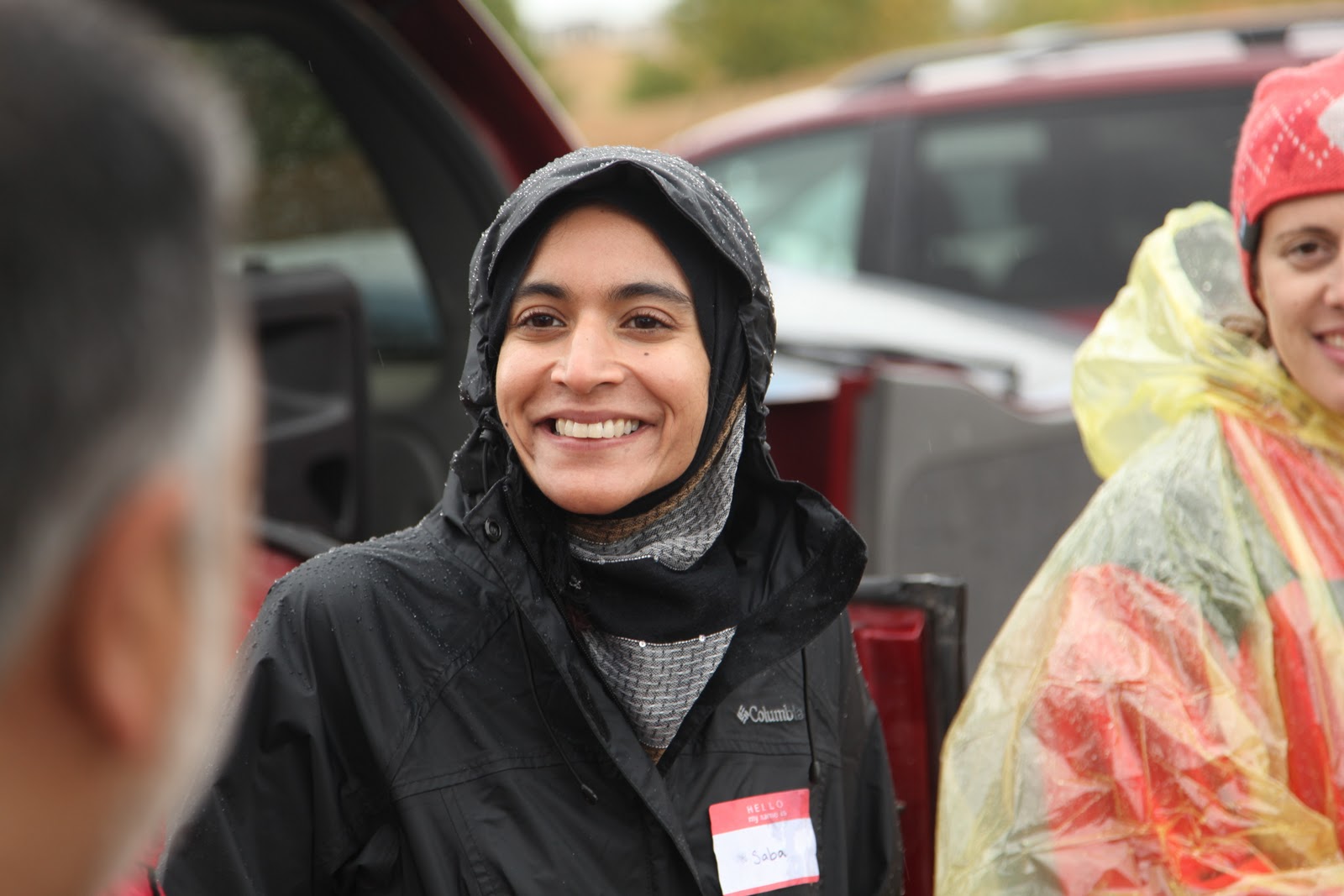
But 10.10.10 dawned cloudy.  As the day wore on cloudy became overcast.  Overcast gave way to drizzle.  And drizzle flowed into solid rain.
Eighty people had pre-registered to join us in tree planting.  Would they all show?  We wondered.
Not only did they show, but 20 others came along as well!  It was a lovely mix of Tongans, Kenyans, Somalis, African-Americans, first generation Americans from Pakistan and Afghanistan, and white folks.  There were children and adults, rabbis and pastors, Tongans in traditional dress, Muslim women with head coverings and Jewish men with yarmulkes.  It was quite the cultural experience.
As one friend put it, “We had Jews, Christians, Muslims and one Republican.”  Needless to say, he was the one Republican.  And even he felt strangely at home.
As volunteers arrived, we checked them in out of the back of a Suburban, with the tailgate down and the window flipped up.  As they signed in, people put on a name tag, with an accompanying sticker to denote their religious affiliation, if any.  And then promptly found others with the same symbol.  Little circles of comfort formed as people waited in the rain for the opening blessings.

“C’mon folks!” I prodded good naturedly, “the whole point of the sticker was to meet someone from a different faith tradition!” I could hear little waves of self-conscious laughter.  Even so, not many moved.  But by the time we began planting, little interfaith groups had formed to plant the trees.
But not before Rabbi Stephen Booth-Nadav sounded a shofar to begin our momentous occasion.  And not before Rev. Peg Newell retold the story of the fig tree that Jesus wanted to curse because it wasn’t producing.  “Just give it one more year,” a servant begged.  In the same way that we say about peace, “Let’s give it one more year and see if it produces.”  And not before Atonio Tolutau prayed in Tongan.  And not before Carema Cook said, “It’s appropriate the the Muslim prayer comes last.  For in Islam we draw upon all the wisdom that has come before us.”

And people stood in the rain and listened and prayed, and smiled.  .
And then we put shovels into the ground, mixed in soil conditioner, and carefully planted trees–living symbols of our ability to restore creation.
Most of the trees came in 5 gallon buckets, so it wasn’t too hard.  But the trust test of interfaith cooperation came when it was time to plant (3) 700-pound trees that Fatuma got donated for us.  One Jew and one Republican worked a two person auger to dig the holes.  Then about 7 people rolled the trees down the hill and into place by the Sand Creek.
As Fatuma helped shovel and then spread mulch around the very large trees, her white head covering accentuating her joyful eyes and bright smile, the Republican said, “This is what I feel best about,” pointing to Fatuma.  “You just don’t see this face of Islam that often.”  “THIS is America,” I said as he shook his head disbelieving, “This is my America.”
It was an iconic moment.
Yes, we planted trees.  Yes, we helped restore the old Stapleton Airport area.  Yes, we created habitat.  Yes, we helped to right ecological imbalances on the planet.  But we did something even greater than that.
We gave people the opportunity to do something they crave:  something unreasonably positive.  And unreasonably good.
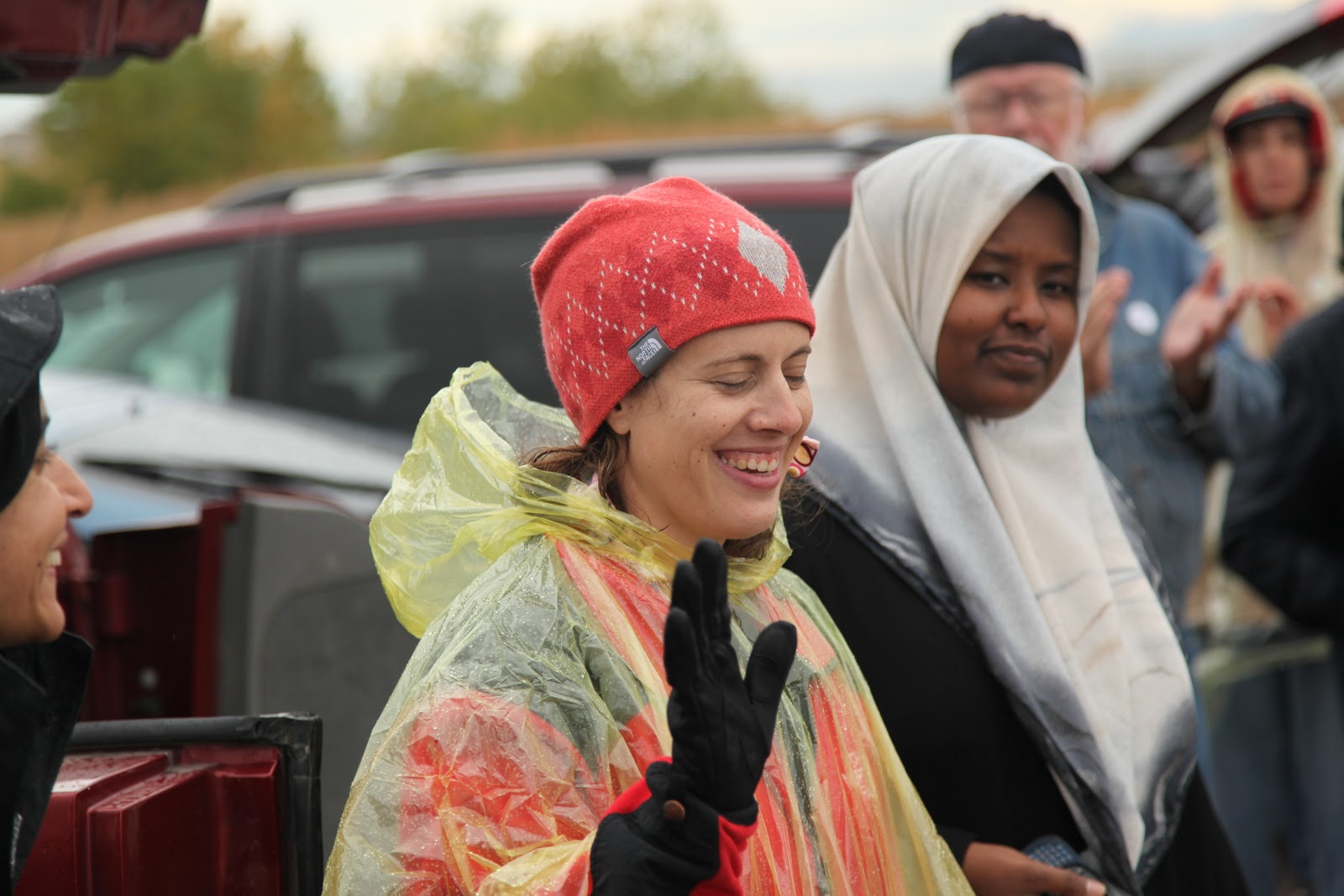
Perhaps the coolest part is that our Peace Forest Project Team doesn’t want to stop meeting.  So Monir, Saba, Fatuma, Jeanette, Betsy, Rae Jean, Ria, Heather, Carissa, Betty and myself are now planning quarterly interfaith dinner and discussion evenings.   And our next planting projects.
It turns out that what we planted was trees.  And what grew was community.

The Participatory Universe

What does it mean to be made in the image of God?

I have been thinking about this a lot lately.According to Genesis 1 where that concept is found, God speaks and the world comes into being. Then God blesses, and multiplies. And the world grows in richness, depth and complexity.
I used to think this notion of creation was weird. God speaks and things come into being? C’mon. Archaic at best. Simplistic and childish at worst.
But I’m outnumbered, by biblical writers anyway. The writer of The Gospel of John declares that Jesus is Logos or Word. You know…In the beginning was the Word and the Word was with God and the Word was God. Pretty heady stuff.
Turns out this idea of creating through the spoken word has a correlate with quantum physics. That is, there is no such thing as objective reality which can simply be observed. Every observer is actually a participant! Since the days of Einstein, we’ve figured out that we live in a participatory universe that responds to our being. What I’m saying is, Word has power. Not just Jesus’ word, but ours too.
Maybe then to be made in the image of God, is to speak/create a world that is rich, blessed, and interdependent. A world that works for all of us of: all people, all creatures, and the planet itself.
So I’ve taken this idea of being made in the image of God seriously. And I’ve been experimenting with speaking a new world into being. One that blesses and enriches everyone and everything.
My current experiment? The Peace Forest. I declared it–without knowing where or how it would be planted. Before we had a place to plant, trees to put in the ground or money to do it, I declared it. Just to see.
Then I invited fellow Jews, Christians and Muslims to help design it. My delightful companions got on board. Now we are all declaring the existence of this Peace Forest. In addition to finding trees, inviting volunteers, seeking donations, and the like.
The cool thing is that it’s working. And something that never existed before now exists. Even before the day we plant. Out of it new community is growing. One that values both religious faith and the environment.
Yup, the spoken word is powerful.
Of course, it
So now I’m asking you to take action to make this a reality: Here’s what I’d like you to do:
1. Speak about the Peace Forest to others. Tell your friends. Announce it in your religious services.
2. Pray about it and give thanks for it.
3. If you can, sponsor a shrub or tree or grove.
3. If at all possible, come help us turn the soil and plant a tree or two. This year, we’re starting with 100 trees. We’d like at least 100 people to help us plant.
You know what’s cool? Not only are we restoring Mother Earth, we are restoring faithful relations with one another.
It is, after all, a participatory universe. The way things are responds to the way we are.
Can I get an Amen?

The Peace Forest

There I sat at a conference table with Betsy, Saba, Fatuma, Monir, and Jeanette. We were not your typical tree-hugger types.  Three of us are Muslim, one is a cradle, Christian, one is a former Evangelical Christian with New Thought leanings, and me, well I’m a United Methodist clergywoman who was born and raised Jewish. (More on that in another blog!) Two of us wore head coverings, and half of us had reached the half-century mark.  Yet, there we were, working out our manifesto for the Peace Forest.

The Peace Forest, an initiative of BridgeWorks, is what I think of as a Mother Earth Mission project. Let me explain.

Often, United Methodists, and other mainline Christians, think of mission work as assisting those in need–whether the needs be material, financial, emotional or even spiritual. We excel at mission work in the wake of natural disasters. For instance, we were on the scene in a jiffy after Hurricane Katrina, the Haiti earthquake, and myriad other storms.

But it’s becoming clearer that it’s not just people who need to be rescued and restored from natural disasters. It’s the earth itself.

As I wrote about in a recent issue of Circuit Rider, ecological imbalances lie at the heart of many natural and unnatural disasters.

Our Peace Forest will address one of them–deforestation–while building bonds of community between different religious people.

This project brings together people from the three Abrahamic Faiths (Judaism, Christianity, and Islam) to plant a living symbol of earth care. One that can make a profound difference for the planet.
But, as Jeanette pointed out, it’s hard enough to unite people around caring for the earth. Let alone embarking on real interfaith work. Perhaps some will be attracted to the environmental aspect of our work and not care a hoot about religion. While others will be deeply committed to interfaith work and not be moved by environmental concerns at all.

Can we work together? Can we find others who will want to work with us?

I feel confident that we will. I’m very jazzed about this idea!

A few years ago, I read A Common Word Between Us. Written by Muslims Christians and Jews it highlights the sacred “words” we share in common such as love of God and love of neighbor.
Reading it, I realized we not only have a common word between us, we share a common world! If we, who can agree on the love of God and love of neighbor, can also discover the common words of creation care in our sacred texts, then we can bring about a positive revolution for each person on the planet.

That’s what the Peace Forest is about: nothing more, nothing less! And it all starts with trees.