Is Your Advent Prayer Missing the Point?

Is Your Advent Prayer Missing the Point?

The Advent the liturgy instructs us to pray—solemnly, hopefully, deeply—is “Come, Lord Jesus, come.”  This hopeful prayer set against the backdrop of darkening days—both seasonally and politically —implies waiting with expectation.  Yet I can’t help but wonder if this prayer misses the point.

What are we waiting for?  We all know Jesus has already come.  While he was here, incarnate on earth, he already showed people how to do what he did. How to bring health to illness. How to bring light into darkness.  How to bring truth to an empire of crushing power.

Instead of waiting on Jesus to work through some heavenly redemption, perhaps Jesus is waiting on us to work some earthly miracles.

During Jesus’ life, he was very clear about sharing his power with his disciples and apostles.  He wanted them to be able to do the very things he did.  To heal the sick.  To cast out demons.  To feed the hungry.  To proclaim the Kingdom.  To expand the ranks with new apostles of peace.

If you are praying for Jesus to do something he has already taught you how to do, then maybe it’s time to take up some new prayers.

I’d like to suggest the following three prayers this Advent:

Pray the Apostle’s Prayer. “Lord, increase our faith.” (Luke 17:5) When the apostles prayed this, they weren’t asking to have more faith in Jesus, but to have more of the faith of Having that sort of faith is what it takes to do the things he did.  And to go beyond it.

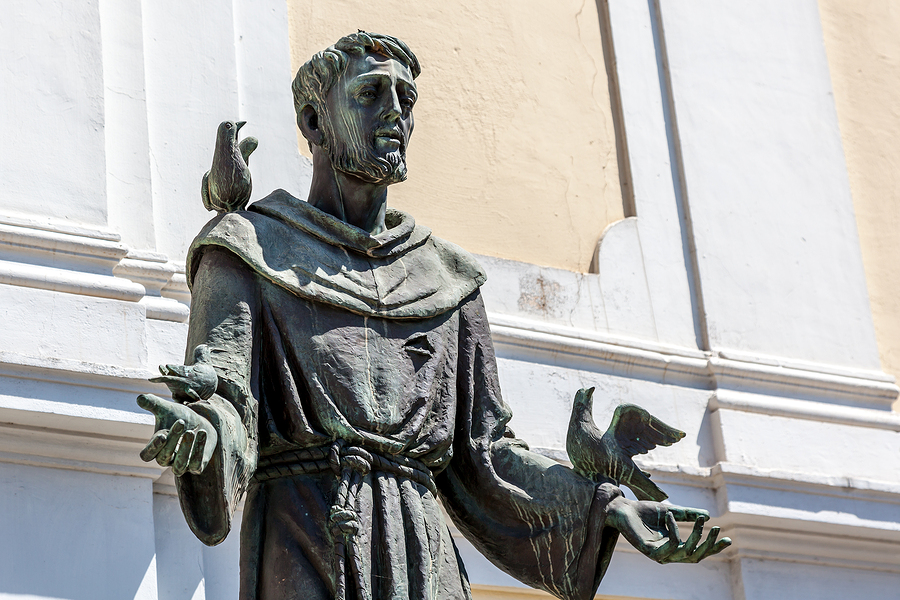
Pray the Prayer of St. Francis. I love this prayer because it instructs me in exactly how to   be an apostle of peace, a force for good in the world.

Lord, make me an instrument of your peace
Where there is hatred, let me sow love
Where there is injury, pardon
Where there is doubt, faith
Where there is despair, hope
Where there is darkness, light
And where there is sadness, joy
O Divine Master, grant that I may
Not so much seek to be consoled as to console
To be understood, as to understand
To be loved, as to love
For it is in giving that we receive
And it’s in pardoning that we are pardoned
And it’s in dying that we are born to Eternal Life
Amen

Pray “I believe; help thou my unbelief.” (Mark 9:24) I pray this prayer when I find myself wavering in my ability to be courageous in the face of evil, or hopeful in the face of darkness.

Praying these prayers will align your life, thoughts, actions and soul with Jesus’ call to us:  to be apostles of peace, healing, comfort, and Kingdom.

There’s one more thing I invite you to do this Advent.  Register for the DARE to Dream Like Jesus course.   You will learn about Jesus’ big dream for the world, the DARE model of dreaming, and how to grow in the faith of Jesus to make a true difference.

Pray “I believe; help thou my unbelief.” (Mark 9:24) Share on X

Should Gender Matter in Christianity?

Should Gender Matter in Christianity?

When addressing Gender and Christianity, a particular example comes to mind.  Specifically the role of women in church leadership.  After telling wildly popular evangelical bible teacher Beth Moore to “go home,” influential fundamentalist preacher John MacArthur clarified his thoughts on women in church leadership. He warned that “empowering women makes weak men” and “weak men make everybody vulnerable to danger.”

Wait a second.  Studies around the world show that empowering women is the key to developing economies, family well-being, better nutrition, and equal rights.  So how could this move be anti-male, anti-social or anti-Christian?

When you take the long view of religious development, I believe MacArthur had it exactly backwards.  Rather than derail Christianity, the full participation of women in all aspects of Creation is the fulfillment of the Christian impulse. 

A look at Judaism reveals why.

Judaism is built on the power of distinctions.  The creation stories exemplify the distinctions between the first six days and the other days of the week; between the sun, moon and stars; between plants and animals; and between humans and God.  The evening prayer in Judaism plays on those themes by glorifying the distinctions between night and day, and between sleep and activity. Havdalah, the blessing that ends the Sabbath, lauds the differences between holy and secular, and between Sabbath and the rest of the days of the week.  Ancient Jewish prayers even prompt men to pray with thanksgiving that they were not made a woman, a gentile or a slave.  Distinctions matter in Judaism.

Christianity goes in a decidedly different direction. 

Rather than playing on distinctions and dualities, Paul has a vision of integration. “There is no longer Jew or Greek, there is no longer slave or free, there is no longer male and female; for all of you are one in Christ Jesus.” (Galatians 3:28) Indeed, women play a major role in the Gospels.

This theme of unity and integration is further celebrated in the New Testament. Consider the story of Pentecost.  When the Spirit comes, all hear a unifying message in their own language. This unity is celebrated as people share in a common life, a common purse, and a common purpose.  Finally, we see in Revelation 7:9-10 that all tribes, peoples and languages have a common trajectory—unity within the oneness of God.

So what’s with the stink about gender distinctions?  Truth be told, MacArthur isn’t the only one who forgets the integrative impulse in Christianity.  Mainline Christian churches have their own version of his call for strong women leaders to “go home.”  Women are called the “B word” and sent packing in more ways than one.

I wonder if the focus on gender isn’t indicative of deeper problems in the church. Like decline in worship, influence, and imagination.  Todd Anderson, a District Superintendent in the West Ohio Conference, told me, “The church is only in decline where the status quo is enforced.”  He should know.  Every District Superintendent is painfully aware of how the status quo stifles new life.  That’s why Todd is working across state lines, district lines, and conference lines to create new, experimental ministries. And they’re bearing fruit.

Decline is not a Christian value. The status quo is not a Christian value.  Women preaching, turning things upside down, is. That’s what lets new life in.

Interestingly even Judaism itself has moved toward integration.  While distinctions still matter, female clergy are beginning to be ordained in the orthodox world.  Even transgender clergy are being welcomed.

Bottom line:  if empowered women are threatening some men, perhaps those men need to deepen their own sense of self, rather than seek to bring women down a peg.

It’s More Blessed to Receive than to Give

It’s More Blessed to Receive than to Give

Last year, I had the opportunity to hear Ed Wingfield, one-time Executive Director of the former Denver Urban League speak on leadership. “Using our current models of leadership, if we’re not careful, a few heroes will rise economically in our community. But no one else will advance. We’ll be in the dubious position of creating victims, so that we can rescue them.”


As I listened to him speak, I realized his was a familiar story. We in the church do that too. Most church mission trips are designed to create a level playing field for the “underprivileged” or underserved. Yet adopting the attitude that “we will rescue you because we are great and competent and able—while you are not”—doesn’t level the playing field. It perpetually tips it. Rather, level playing fields come from empowering people to discover their own greatness, competency and ability.


With the summer mission trip season upon us, it’s time to re-imagine mission trips. That means discovering the blessing of receiving, not giving. 


Years ago, I had been on several mission trips to Rosebud Indian Reservation, home of the Lakota Sioux in South Dakota of “Dances with Wolves” fame. We would paint homes, do minor repairs, and in the evening learn about history, customs and if we were lucky, experience a sweat lodge. We were excited to paint homes and make a difference for “underprivileged” people. We felt good about it. 


But I didn’t know how our efforts actually came across until Chesie Lee, an ally and advocate for Native American empowerment let me in on a little secret.  Chesie, who co-facilitated the creation of the Wind River Native Advocacy Center together with members of the Northern Arapaho and Eastern Shoshone tribes, told me a common response to the question: “Who wants to have their house painted this year?” is typically “Nah, I’ve had mine painted 3 years in a row.”


All that house painting was for us, not the people who lived in them.  In other words, our focus on giving wasn’t really meeting needs. Yes, we felt blessed to give, but it placed those on the receiving end in a dependent, less-than, victim role.


Chesie had seen this dynamic play out over and over.  Several years ago, when she served as the Director of the Wyoming Association of Churches, she realized that mission trips designed to “help” Native Americans didn’t necessarily help. Playing rescuer to Native Americans was ironic since the church had been instrumental in creating the victimization of Native American populations to begin with.


Chesie saw that Instead of organizing traditional mission trips to the Wind River Reservation, in which churches would come paint or repair homes, she could invite church groups to come to the reservation to learn from the Native Americans. She could switch the paradigm from rescuer-victim to co-equals.

In this way, Native Americans would be granted the gift of agency. Of moving away from the role of invisible, underprivileged people to real live human beings with something to offer to others. These trips would be for mutual education and uplift.


It was a tough vision to communicate. Many churches resisted the idea that coming to receive would be as worthwhile as coming to give. The few who did come discovered something of a new connectedness and a different view of history. They discovered something of the Kingdom within.


As you plan summer mission trips this year, ask yourselves these questions:

  1. Will our mission trip create long-term empowerment for those we aim to serve? Or will it leave them dependent on us?
  2. How can this experience be mutual in nature?
  3. What are we willing to receive from the people we are there to serve?


This summer consider how you can experience the blessing of receiving by allowing others to give.  Alternatively, you can re-paint homes that don’t really need it.


Adapted from the forthcoming book Dream Like Jesus, by Rebekah Simon-Peter, Market Square Publishing, 2019.

Debate as Sacrament

Debate as Sacrament

At one church I visited recently, a long-time member confided that the church was going to have to split because the two pastors had differing views on human sexuality and the Bible.

Why can’t our differences live side by side?  They do in the Bible.

There are two creation stories, two exodus stories, two accountings of how many animals piled into the ark.  Kings and Chronicles have alternate views of history.  The four gospels themselves   tell differing stories to differing audiences.

Why is it that we in the church see difference, debate, and conflict as unholy?

Difference and debate are woven into the biblical story. Abraham dickers with God.  Jacob contends with the Angel throughout a long night. God and Moses have an equally challenging relationship with each other. Jesus is in constant debate with his followers, his community and his opponents.

As uncomfortable as conflict is, it’s in these encounters that sacred truths are revealed, and holy moments are elevated. It’s time to reclaim debate as sacramental.

When it comes to sacraments, debate is messier than spilled grape juice, scattered breadcrumbs, and overflowing baptismal waters.  But not messier than the events that gave rise to these symbols.

Conflict is a natural part of human community. Conflict doesn’t need to split your church.  As long as you know how to talk to each other.  But even more importantly how to listen.  That requires self-regulation, a key element of emotional intelligence.

When in the midst of conflict, remember the word CALM:

C:  Calm down.  Breathe.  Pause.

A:  Assess your automatic thoughts.

L:  Listen to what was actually said instead of how you interpreted it.  Listen with your heart and your head.

M:  Make a new response.

For more leadership tips, click here.

Remember, conflict and debate is natural – remain CALM in the face of conflict.

Beyond Thoughts and Prayers

A flurry of well wishes were unleashed across the United States in the wake of the Dayton and El Paso shootings ten days ago. These well-meaning expressions of sympathy were tweeted, emailed, texted, written, preached, and whispered:  You are in our thoughts and prayers. 


While words of comfort are always appropriate, in and of themselves, they are increasingly inadequate as a ministry response.  Maybe thoughts and prayers were an adequate response after Columbine.  But here we are 20 years later.  What was an isolated incident of horror has become a public health crisis.  So much so that in 2019 there have been more mass shootings than days in the year.  According to Gun Violence Archives, a mass shooting is defined as four or more people killed, not including the shooter.


As a nation we seem to be stuck and paralyzed, unwilling or unable to prevent further mayhem.  Is there anything the church can do when the government can’t or won’t?  Absolutely. As vessels of divine love, who carry light into the world, you are empowered to co-create new realities with God.


How does this spiritual reality translate into visible action? It involves shifting your focus from comfort ministries to challenge ministries. 


Jesus engaged in both kinds of ministries.  He not only healed others who suffered the crippling effects of sin and powerlessness, he created a new kind of community in which those distresses couldn’t take root. Because you are made in the image and likeness of God, you can do the same.


Let’s take a look how.


Up until this point, comfort ministries have been primarily employed in the case of mass shootings.  Thoughts, prayers, impromptu memorial sites, community services, and counseling for the bereaved have pulled together traumatized communities. But they haven’t bound up the brokenhearted families or brought the dead back to life.  Nor have they put a halt to public shootings at the movies, food festivals, concerts, yoga classes, and stores.  They haven’t stopped a gunman from killing people in church, synagogue, school, or at home. Because they haven’t dealt with the why or the how of the violence.


Challenge ministries get at root causes.  What are some of the root causes of these shootings?  One common denominator is domestic violence. Investigations are beginning to reveal that many of these gunmen have a history of domestic violence.  This is compounded by the ready availability of military-grade weapons, coupled with an inadequate system of background checks, and spurred on by a darknet of hate-promoting sites. It all brews in a culture of toxic masculinity and fear of loss of power as the US and world population grows increasingly multicultural.  This fear of the “other” includes a fear of black and brown-skinned people, Jews, Muslims, Christians, Amish, gays, Mexicans, immigrants, and women.  It’s made all the more heinous by a lockdown on treating this as a public health crisis. 


What can you do in the face of this?  Keep reading to discover five ways. But first, let me invite you to join me for a free one-hour webinar to discuss how to respond to mass shootings, Beyond Thoughts and Prayers: Responding to the Unthinkable.  Email us to register and receive a link.


Back to the five steps.  But first, before I tell you what they are, be aware that they will require all the courage the Christian life has to offer.


  1. Remember who you are. You are made in the image and likeness of God.  As a follower of Jesus Christ, you bring love and light into the world.  As a partner with the Holy Spirit, you co-create miracles through willingness and faith.


  1. From this space, forgive the shooters, the factors that led to their violent deeds, and the paralysis of the nation. If you can’t do that, imagine God’s unconditional love and Jesus’ forgiveness for them even in the midst of the evil. If you can’t do that, at least ask God to help you set those feelings aside temporarily.  Why?  If you meet their anger, hostility, loathing and fear with your own, then the atmosphere of us v. them has simply increased. Love and light cannot win in that environment.  And love and light must win.


  1. Next, lift up your thoughts and prayers in a brand-new way. Turn your thoughts to the covenant you have made with the community of faith: “To accept the freedom and power God gives you to resist evil, injustice and oppression.”  Pray on those words.  Gently turn aside the thoughts that say you can’t make a difference.  Go back to praying. Couple that with reading Matthew 17:20 and John 14:13.


  1. After this, redirect your attention from the trauma at hand to an expansive vision of the Kingdom. What would a community look in which the thought of shooting others wouldn’t even occur for people? In which a violent fear of the other couldn’t take root? Envisioning this will take holy imagination, creative conversation, and much prompting of the Holy Spirit.  Allow the Spirit to take you there.


  1. Ask God what action or actions you can take toward that vision. Be aware that this will require more than one person or a few people to accomplish.  And likely more courage than you currently have.  Be brave.  Be faithful. Trust that God trusts you to do this.


Do share this process with others.  Invite them to forgive, to re-direct their thoughts and prayers toward the freedom they have to act, to envision the Kingdom, and to choose an action.  

3 Deadly Sins of Leadership

In many churches, this is the time of year when pastors are settling into their new appointments, and congregations are learning to work with their new pastors. In other churches, people are starting to come back to worship.  Across the board, committees are beginning to reconstitute, fall plans are being made, and activities are gearing up.


As you connect or reconnect with your people, and prepare for a season of ministry, you may stumble unwittingly into the three deadly sins of leadership.  Although well-intentioned, these sins are deadly because they snuff out aliveness. Not only that, they generate unnecessary conflict.


Read on to discover the three deadly sins of leadership, their deadening effect, and how to keep calm in the midst of conflict.


Here are the three deadly sins of leadership.


Sin #1.  Trying to be all things to all people.  Wholesale people-pleasing never works.  First, because it’s impossible to know what everyone needs.  Second, because people won’t know the real you.  Third, because it demands too much of you, and not enough of them. 


Community is based on give and take.  People-pleasing takes away the need for people to show up as they are, and to work through the challenges of being community. Anything less is deadening.


People-pleasing leads to internal conflict.  Let’s say you give up your day off to attend to someone’s need. But the needs are never-ending.  So, what’s next—your vacation time?  If so, it won’t be long until you’re giving up your convictions. 


The one who suffers the most will be you:  you’ll be resentful, feeling taken advantage of.  And it won’t be anyone’s fault but your own.  People-pleasing is always a choice. Yet, it takes great strength of character, great emotional intelligence, to be true to ourselves. 


Sin #2. Make no changes.  Or change everything.  Life is full of change; now more than ever.  We are living in a time when the rate of change continues to accelerate. Pretending like you’ll never change anything is unwise and dishonest.  Equally unwise and dishonest is acting as if everything in place needs to be scrapped. 


When I began local church ministry, I abided by the rule to make no changes in the first year.  What I didn’t know was that people were eager for me to make changes.  They were tired of being stuck.  When I was slow on the uptake, they grew more resigned, and more contentious. Following the rules was safe for me, but deadening for them. 


Pacing change appropriately reduces resistance, eases conflict, and builds buy-in.


Sin #3.  Assume your emotional or spiritual space is universal. For instance, just because you are arriving fresh and sassy, full of ideas and open to the Spirit, doesn’t mean that they are.  Or just because you are tired and burned out, doesn’t mean they are.  One of the challenges of pastoring a congregation of differing ages, personalities, and life experiences is that not everyone is in the same spot, ever. 


Conflict comes when leaders don’t recognize the deep work that the Spirit has been doing in that place for generations. Or when they don’t pay attention to the promptings of the Holy Spirit they are receiving.  Either approach stymies the work of God.


Congregational Intelligence If sin is missing the mark, then salvation is collaborating with the Spirit.  This collaboration takes courage, and resilience.  It also requires trust in yourself, an ability to sense the Spirit, and an understanding of how to read and lead the people around you. Together, these qualities comprise what I call congregational intelligence. Finally, knowing how to self-regulate during conflict is essential.


Not sure how?  Register for a free 45-minute webinar on “Keeping Calm in Conflict,” Noon Mountain Time on August 30.


In the meantime, notice what is happening in your spirit.  Are you feeling less than alive?  Deadened?  Perhaps you have stumbled into practicing these leadership sins.