by Rebekah Simon-Peter | May 9, 2016
General Conference is a quadrennial gathering of the global United Methodist Church. But by definition, this global gathering is intensely local. Local dialects, languages, costumes, greetings, and worship practices take center  stage. This convocation begs the question: What, if anything, does a global UMC mean for a local congregation? I posed that question to a handful of young United Methodist clergy with whom I recently met.
“I bring in different worship styles from other countries to our local church,” Sara Rettig, a pastor from Appalachia serving in the Rocky Mountain conference explained. “I make sure they are incorporated in my congregation. We talk about how our way of worshipping isn’t the only way.”
Other young clergy shook their heads. “A lot of time we don’t think of ourselves as a global church. We’re just busy trying to make things happen in our own setting. How can we focus on bringing in more global aspects to our local church instead of just catering to our own needs?”
Many churches find a way to highlight the global church on World Communion Sunday. Greetings and prayers drawn from other languages are a good way to highlight our unity in diversity. But is a once a year shift in perspective enough to create a true sense of community?
Other churches engage in annual or bi-annual mission trips to connect with sister churches across international borders. Always enlightening and uplifting, these opportunities, however, can reinforce a sense of “us” and “them.” We have the resources; they have the needs. We have the answers; they have the deficits. Is that what we envisioned when we set out to create a global denomination?
Sara’s next thought pressed the group: “What does it mean to have different theologies, and be an open church where all of us can be who we are and still be part of a connection?”
Good question. It made me wonder if that’s even allowed in the UMC. We have it, of course, but do we actually acknowledge it or welcome it?
As one young clergy leader pointed out, “The UMC tends to prize uniformity over unity.” That would seem to undermine Sara’s point of inherent diversity in a global church. But maybe the pressure for uniformity boils down to just a few select issues.
“We have one Book of Discipline that assumes we all look at issues in the same way,” said Sara’s husband, Major, also serving in the Rocky Mountain Conference. “For instance, take human sexuality. In some parts of Africa, the primary concern is over polygamy. In the US and Europe, we’re up in arms over homosexuality. If we’re really a global church, how come our Book of Discipline doesn’t reflect that?”
“True,” noted Dustin Burrow, serving in the New Mexico Annual Conference. “How can one Book of Discipline even cover places as disparate as Eastern Europe, the American Southwest, and the African continent?”
The dance between unity and uniformity, the global and the local isn’t new for Peoples of the Book. Think of it: we have four different gospels that give four fairly different accounts of the life of Jesus. Two of them don’t even recount a birth story. The two that do supply radically different details. That same pattern continues all the way through the life, death, resurrection, and ascension of Jesus. Not to mention the Hebrew Bible or Old Testament. It contains two different creation stories, two exoduses from Egypt and a plethora of names of God. Even so, throughout the testaments, you can still detect unifying themes of creation, covenant, sin, forgiveness, and redemption. Then there’s the matter of the Trinity itself—God in three persons.
If the Bible itself conveys unity without requiring uniformity, maybe there’s hope for us!
Especially if we were to take a page from Jesus and his tribe. Judaism, from ancient to modern-day times, intentionally cultivates a diversity of voices and viewpoints by which to understand God and God’s will. Books like the Mishnah and Talmud even record these voices in conversation and are studied to this day.
My point is that enforced uniformity across a global denomination like the UMC is actually a disservice. It erases the very things we can learn from each other—the varying ways we read scripture, do mission, understand the world and even our own selves.
Unity in the midst of diversity is not only Biblical, it’s Wesleyan. John Wesley famously wrote, “If your heart is as my heart, if you love God and all mankind, I ask no more; give me your hand.”
Our unity as a global denomination can become a source of inspiration, curiosity, and growth. Not a condemnation of differences. Or a striving to be exactly the same. But rather an expression of God’s own unity in diversity. Let’s see what that would mean for local churches scattered across the globe!
Thanks to Ministry Matters where you can see this and other blogs by Rebekah Simon-Peter.
by Rebekah Simon-Peter | Feb 3, 2016
Agree or disagree: people have to be told how to connect to God or what to say to God, God speaks only to the few and the well-placed.
If you disagreed with the above, then you are ready to experiment with crowd-sourced worship.
I discovered crowd-sourced worship the hard way. In my typical fire-ready-aim fashion, I had forgotten to plan details of a closing worship service. Here it was, the last day of our 3-day retreat. Everything else had gone really well; the group had bonded, transformations had taken place; the Spirit had moved. Would it fall flat on its face because I had forgotten this all-important detail?
I knew we would have Holy Communion, and that’s about it. As the group of eight church leaders sat in the loose circle that would be our closing worship, a moment of clarity came. Liturgy means work of the people. If the worship service were highly scripted, it wouldn’t be the work of this people. A pre-printed liturgy would be an oxymoron.
I prompted them through the Order of Worship in the United Methodist Hymnal, asking at each point who had something to contribute. From Call to Worship through Benediction, the Spirit moved. I provided a brief reflection and led Holy Communion. Others bookended this with a favorite scripture reading, creative words of reconciliation, simple songs, touching prayers, and even a joke that fit perfectly. I never could have planned something so good. The worship service unfolded through us. It was surprisingly satisfying.
I have since used this format purposefully. The more I trust the process, and even prepare people ahead of time, the better it gets. Each worship reflects the group that is present, and the experiences we have shared.
It occurs to me that while pre-scripted worship has a long and solid history in both synagogue and church, it seems to presume several things that are just plain wrong:
- People have to be told how to connect to God
- One person, or a group of others, knows best how a whole group ought to connect with the Holy
- Scripted worship is the work of the people
Bill Wilson, twentieth-century practical theologian and co-founder of Alcoholics Anonymous wrote, “Deep down in the heart of every man, woman and child is the idea of God.” Since we are each made in the image and likeness of God, I’d take that one step farther: “Deep down in the heart of every man woman and child IS God.” That makes talking to God, celebrating God, and worshiping God the most natural thing any person can do. It positions crowd-sourced worship as a viable way to conduct corporate worship. Moreover, it allows the church to stop over-functioning and to put liturgy back in the hands of the people.
Personally, I find corporate worship much more satisfying when there’s space for me to contribute. Even if it’s simply space to speak to God in my own words during silent prayer. But most silent prayer isn’t silent. And it lasts about 10 seconds. Not long enough to connect.
If you’re ready to experiment with crowd-sourced worship, keep in mind these PERKS and PERILS.
PERK #1 Because of the nature of crowd-sourced worship, worshipers feel empowered to truly respond to the movement of the Holy Spirit. Worship feels less rote and more like a dance.
Once, at Communion, I turned in the circle to serve James, the first person to my right. Then James turned to his right to serve Cassie. Then the two of them together—who didn’t know each other before the retreat—turned to serve Kenzie. James held the bread, Cassie the cup. From then on, two turned to serve the next one. The ritual evolved without a word of instruction; it just naturally morphed.
PERK #2 It’s high expectation worship. It raises the bar of what is possible and do-able in the church as people gain confidence in their ability to connect with God. At one crowd-sourced worship experience, the energy in the room was palpable. We had just pulled off something that others had not thought possible. One pastor said on her way out to me: “I didn’t think that would be possible. But God really did speak through all of us today. I want to try this with my home congregation.” I imagine that she went home and is now empowering her congregation to discover their own personal connections with God.
PERK #3 You can start small. In fact, you have already started. If you ask for prayer concerns, offer times for testimonials, or ask people to call out their favorite hymn you are doing crowd-sourced worship. If you ask people to respond to the sermon or talk to their neighbor, you are dabbling in crowd-sourced worship. One gifted pastor I coach helps people easily greet each other by printing a different question in the weekly bulletin that people may ask each other: “How many people in your family?” Or “What are you grateful for today?” The pastor of a new church plan, ICON, invites people to respond to the scripture and the sermon using an artistic medium—clay, paint, etc.
Just as there are PERKS, there are PERILS that must be guarded against.
PERIL #1 Dominance. The same people speak up over and over. In this case, the work of the people becomes the soapbox of one or two persons. Some pastors I know have discontinued spontaneous “Joys and Concerns” because they devolved into weekly updates of one or two person’s failing health.
PERIL #2 Uncertainty. You may open up to rants and raves that would be inappropriate or hurtful. I once unwittingly gave an opening to the wife of an unhappy Chair of Trustees. She let loose on the whole congregation for their perceived faults and failings. I was stunned, unsure of what to say. In retrospect, I see that she was naming a situation I could have headed off at the pass had I been more savvy. It gave me important information, but not delivered in the way I would have preferred.
PERIL #3 Lack of participation. There is the chance that no one will say anything. Unless you’re used to Quaker meetings where that may be the case, or your people are quite comfortable with extended periods of silence, this can be quite unnerving. Given a bit of advance notice, guidance, and patience though, this can be avoided as people grow in their confidence to contribute. You can also set ground rules that make clear: no dominating, no rants or raves, and everyone has something to contribute.
Crowd-sourced worship breathes new life into old worship forms. It trusts that God is at work. It allows the movement of the Spirit to be recognized and expressed through us and among us. It refreshes and empowers. And it puts liturgy back in the hands of the people.
by Rebekah Simon-Peter | Oct 12, 2015
The recently released movie The Martian starring Matt Damon tells the not-so-far-out tale of botanist Mark Watney left for dead on the planet Mars. His fellow crew members have reluctantly left him behind to undertake the 4 year return voyage to Earth. When he comes to after being knocked unconscious he is faced with a series of catastrophic realities he must tackle in order to survive.
While not explicitly a story of faith–Watney says he’ll have to “science the s&!# out of things”–it’s a great metaphor for the church in this day and age.
Watney is up against what David and Goliath author Malcolm Gladwell calls “desirable difficulties” which hone his imagination and capitalize on his desire to live. Much like dyslexics who innovate and orphans who excel precisely because of their difficulties, Watney rises to the occasion, and [spoiler alert] survives. Indeed, thrives.
The church has a history of thriving when the chips are down. We grow comfortable and weak when all is well. We would do well to remember our rocky history when bemoaning our post-Christian world and spiritual but religious cohorts. What can the church learn from The Martian? Here are 10 Commandments for a Martian Church.
- Thou shalt step into the unknown. The premise of The Martian is the courage of astronauts to go to Mars and to set up camp in an unforgiving environment. Getting left behind in that environment pushed the uncertainty principle to the max. Congregational survival similarly calls for a willingness to purposefully move into new territory. We can’t sail new seas and stay in a safe harbor at the same time.
- Thou shalt flex thy faith muscles. Watney doesn’t express an explicit faith in God. But he demonstrates faith in himself and his training. That faith is tested time and again. Instead of weakening under scrutiny it grows stronger. Here’s the thing, church: certainty does not require faith. Only uncertainty does. In the early years of the life of the church, no one was sure if this thing would survive or if all the followers of Jesus would be martyred. Following him took a vigorous, muscular faith. Our faith muscles, by contrast, are fairly weak and flabby. What if we were to embrace uncertainty as an opportunity to grow stronger?
- Thou shalt embrace pain. The first obstacle Watney encounters might have done the rest of us in. In order to not bleed to death, he has to perform painful surgery on himself. It would have made sense for him to lay down and die right then and there. Instead, he is willing to endure more pain to get on the right track. Is your church embracing the pain of corrective self-surgery or is it bleeding out?
- That shalt not blame. Watney demonstrates remarkably good humor and compassion in the face of intense isolation, seemingly insurmountable odds, and several failed attempts at survival. He doesn’t blame his crew, Mars, NASA, God, or himself. Instead, he understands and approves of the decision his crew made. He goes to work with what he’s got. How much energy do we waste on blame when we could be putting it toward creativity and faith flexing? Things are the way they are. Let go of blame and get on with it.
- That shall not covet thy neighbor’s success. Watney doesn’t get lost in the fantasy that life would be better if only… Covetousness blinds us to what we do have. The next time you drift into envy over megachurches, famous pastors, large budgets or fabulous buildings, you are wasting precious energy on fantasy. Do like Watney: improvise, improvise, improvise. That too is the stuff of faith.
- Thou shalt fail. Being willing to fail is the only way to truly succeed. Watney had to put his limited resources on the line in order to figure out what would actually work. He failed, and failed big. More than once. But those failures are what pushed him to ultimately succeed. When the church is unwilling to fail, or to lose only a little, it is also unwilling to succeed big. Big fails require big faith. Big faith leads to big breakthroughs.
- Thou shalt not be blind. Only one thing drives Watney’s efforts: his desire to live. This vision pushes him through pain, failure and the seemingly impossible. It gives him the courage to try things that seem impossible. If your church is not operating with a fresh and compelling vision, it’s hard to imagine you’ll do more than limp along until death.
- Thou shalt give thy all. At one point, Watney must concede that he may in fact not make it. He asks the Commander to break the news to his mother and father, if needed. “Tell them I love them. Tell them I loved my work. Tell them I have died in the service of something greater than myself. And that it was worth it.” If your church has tried everything, failed, and must die, be proud that you gave your all.
- Thou shalt give back. After Watney comes back to Earth, he gives back. Another person might have hid away and nursed their wounds, or gone on a vendetta. Not Watney. He becomes a professor of aspiring astronauts, helping them navigate their fears and concerns. Every congregation, no matter the size or budget, can give something back. We don’t exist in a vacuum. When we refuse to give back, we refuse to participate in the cycle of life. Our stinginess will come back to haunt us. One small congregation I know of is so concerned about its own survival that it prefers to hoard its sizable bank account rather than share it with those in need now. Stinginess does not inspire faith, deliver hope, or bring the Kingdom. Give back or pay it forward.
- Thou shalt not coast. When Watney returns, he reveals the grit that got him through. People ask him: Did you think you were going to die? “Yes,” he says. “Space is unforgiving. Things will go wrong. You solve one problem. Then the next. Then the next. And if you solve enough problems, you will live.” Does your church ignore its problems, confusing denial with faith? God does not do for us what we can do for ourselves. Coasting is not faith. Coasting is laziness.
The lessons of faith are all around us. Even in sci-fi movies. So don a pair of 3D glasses, and head to the theater. Then, thou shalt consider the 10 Commandments of a Martian Church.
by Rebekah Simon-Peter | Oct 5, 2015
Bishop Schnase, your book Just Say Yes! addresses how to unleash people for ministry. It’s an empowering and inspiring read. In it, you write about “unspoken shadow missions that actually drive behaviors or limit alternatives more than the stated mission and adopted values.” The local church pastors I mentor definitely encounter shadow missions in their churches. Do you believe the UMC as a whole has a shadow mission? Does it impact or hinder local churches? If so, what can be done to set local churches free?
Many churches operate with explicit vision statements that define their distinctive role and identity—Leading People to an Active Faith in Christ, or Building an Outwardly-Focused Christian Community in the Life of Grace. Others adopt the denominational mission or rely on a common language to shape congregational behavior—Making Disciples of Jesus Christ for the Transformation of the World, or Open Hearts, Open Minds, Open Doors.
However, churches sometimes operate with unspoken purposes that actually drive behaviors more than the stated mission and adopted values. The logo uses missional language to motivate but leaders actually rely on maintenance language to make decisions.
In effect, an unspoken shadow mission says that our true priority is to fulfill one or more of the following: Preserve the building. Keep everyone happy. Don’t offend the choir. Maintain a family feel. Don’t ask for money. Protect the endowment.
Most shadow missions are driven by fear—fear of conflict, of upsetting someone, of financial stress, of loss, of change. Energies are redirected toward security and survival, leaving little space for creative initiative. The answer is No to anything that challenges or threatens the shadow mission, even if an initiative has great potential for changing lives or reaching people. A shadow mission is like a magnet set beside a compass, an unseen force that draws us off course from our true mission.
Your question about shadow missions in the denomination and the effect these have on congregations is provocative and worth exploring. Several possibilities come to mind, but I will offer only two.
First, a significant shadow mission in the UMC is the constant pressure to preserve the status quo, to maintain current systems, and to require everyone to do things the same way as everyone else without regard to local context. The United Methodist Church has built systems and developed deep-running expectations that mandate extraordinary uniformity of operations at the local church, conference, and general church levels.
A conference that colors outside the lines is seen as problematic. For instance, if a conference experiments with a better way to offer Course of Study, or explores new expressions of campus ministries, or adopts non-traditional approaches toward camping in order to reach more young people, or rethinks its apportionment formula, or endeavors to improve supervision and intervention processes for clergy, then the conference is viewed as creating a problem to be solved by general agencies, the judicial council, and by other conferences. Instead of encouraging innovation and imagination, we pour inordinate energy and resources into controlling outliers, even when the experiments are wonderfully effective at expanding ministry, increasing effectiveness, and extending our mission.
An innate institutional conservatism pervades the denomination. I’m not talking about theological or political conservatism so much as a fundamental resistance to adaptive change. A conference or congregation that takes an alternative pathway, even a successful one, is seen as rocking the boat. In response, more rules and restrictions are embedded into the system. Everyone agrees that our conference operations, our General Conference processes, our seminaries, our clergy credentialing methods, and our financial systems are not working well in today’s environment, but the innate institutional conservatism makes it nearly impossible to effect major change.
A second shadow mission is our seemingly unalterable allegiance to a structural connectionalism rather than to a more fluid, adaptive missional connectionalism. We confuse our connectional roots and identity (which were missional and worth preserving) with the particular expression of connectionalism that has emerged in the last 50 years. The Council of Bishops, the Judicial Council, GCFA, the general agencies, the concept of annual conferences as business sessions and of General Conference as a legislative session—we behave as if these have always been with us and must continue in their current forms if we are to remain connectional. In fact, none of these existed until a few decades ago or in the earliest expressions of Methodism when we operated with a more missional connectionalism. In our origins, every expression of connectionalism was intended to multiply impact and extend the mission—the creation of circuits, use of laity, conferring annually to reinforce identity. John Wesley did not establish chapels and preaching houses and societies so that one day he could preside over a conference; he formed a conference in order to multiply the impact of chapels and preaching houses and societies.
The combination of these two shadow missions—to protect the status quo and to maintain the current structural connectionalism–keeps us from learning and experimenting and innovating. These shadow missions preserve prerogative, focus us on survival, foster denial, and permit avoidance tactics. In a time of diminishing resources, these shadow missions feed competitiveness, conflict, and territoriality as each part of the church maneuvers for support. These shadow missions imbue creative people with a sense of helplessness, the feeling that nothing can be done. Monolithic intransigence makes us ever more irrelevant and ill-equipped for meeting the overwhelming human needs we face in our society and around the world.
Simply naming a shadow mission does not free us of its power, but it’s a first step. We need to foster more innovation, imagination, and experimentation rather than continue to insist on uniformity and control.
 In Just Say Yes, I mention the idea of “dancing on the edge of our authority,” a concept borrowed from Marty Linsky. If we only operate within the authority given us and according to the expectations of the organization, we will never lead the change that is necessary. The community will fail to adapt to the changing environment and will slowly die. Complacency and stagnation wins. We have to exceed our authority in order to lead the organization toward places it will never ask us to go.
On the other hand, if we don’t give proper attention to the existing expectations and fail to do the work the organization has authorized us to do, we’ll be rejected. We must meet the fundamental expectations so that we don’t lose trust, disconnect, and become leaders without followers. Managing expectations involves maintaining and improving existing systems, and this is important work. Leaders tend to be rewarded for caring for the organization and working for “what is” rather than for stimulating change and focusing on “what is not yet.”
“Dancing on the edge of our authority” involves meeting enough of the existing expectations to stay connected and to foster trust while also pushing the organization to boldly take initiatives that fulfill the mission. This leads to your last question: How do we set local churches free?
Conferences get just as stuck as congregations do. Conferences need to unleash churches for ministry just as churches need to unleash people. This means less centralized control so that churches can start churches, experiment with second sites, initiate conversations about adopting sister congregations, and establish campus ministries. With a missional focus and high expectations, we can practice a guided autonomy that permits and encourages congregations to take more initiative, to dance on the edge of their authority, and to practice greater innovation. When we set congregations free, we encourage healthy churches to take responsible risks consistent with their mission to relieve suffering, proclaim justice, and meet human need across the globe. We stop trying to squeeze everyone into the same mold. We practice ministry as an improvisational art, just as Wesley and the early Methodists did with their bold experiments. This does not mean that anything goes; Christ-centeredness, excellence, fruitfulness, and accountability must be expected. The book Seven Levers: Missional Strategies for Conferences gives countless examples of how Just Say Yes! Unleashing People for Ministry works at the conference level.
Robert Schnase serves as Bishop of the Missouri Conference of the  United Methodist Church, and is the author of the bestselling books Five Practices of Fruitful Congregations, Five Practices of Fruitful Living, Practicing Extravagant Generosity, and Seven Levers: Missional Strategies for Conferences. His latest book, Just Say Yes: Unleashing People for Ministry, is written for people whose passion has been simmering for years, who yearn to be told Yes! Schnase examines the systems and attitudes that restrain and control ministry. He demonstrates practical ways church leaders can rethink fundamental assumptions about organizations and leadership.
Downloadable resources are now available to help local congregations unleash people for ministry, including supplemental videos, invitational postcards, a leader retreat guide and a 7-session devotional guide. Visit www.SayYesToMinistry.org.
by Rebekah Simon-Peter | Sep 8, 2015
Once upon a time, I was a young clergy person. I was full of passion and verve, hope and vision. My call was fresh. My courage was strong. The first church I served, an African-American congregation, was every bit as exciting as I’d hoped it would be. But as I continued on in ministry, I seemed to meet with more resistance. Was it me? Or was it them?
In hindsight, I think it was a little bit of both, with a large portion of rapid culture shift thrown in for good measure. I had a chance to test my assumptions last week when I  met with a baker’s dozen of young clergy from around the country. They’re part of a select group I have the privilege of mentoring in how to create a culture of renewal. While we were together, I figured out the trouble, the glorious trouble, with young clergy.
Young clergy around the country are doing amazing ministry. There’s the Minnesotan who launched a worshiping community that embraces earth care as a de facto matter of Christian stewardship. I think of the bright visionary in my own region, Rev. Stephanie Price, who is starting a new congregation with a piece of land. Then there’s the pastor who is organizing a congregation around food and table fellowship.
But it’s not just avant garde ministries that attract talented young clergy. At last week’s retreat, I met high church aficionados, deeply earnest pastoral caregivers, culturally savvy leaders who welcome otherwise marginalized GBLTQ folks, and disciples who have had unforgettable spiritual awakenings. Their ministries are all taking place within established congregations.
Yes, they are up against shifting cultural expectations, a rapidly moving world, and a certain measure of resistance to change. But for all the talk of decline in the local church, these young men and women are signs of local church vitality, denominational structures that functioned well, the enduring power of Jesus’ vision, and the insistent, cajoling voice of God which got through to them.
No, they’re not perfect. Who is? But they are awesome; the future is in good hands. Here’s why I think so. In other words, here is the glorious trouble with young clergy:
- They refuse to stay down. As a young clergy person, I got into stinking thinking, convinced that church decline was somehow my problem. If I could do more and more, and get better and better at it, the church would magically turn around. That line of thinking got me down, and wore me out. These young clergy understand the problems with denominational church in the 21st century; they’re not in denial. But they stay inspired by their call, signs of the Kingdom, and the small wins that lead to larger wins.
- They network. I participated in coaching groups and regular continuing education events, but these clergy have so many more options than I did when I was starting out. More than ever, denominations are inventing life-giving ways to help new clergy stay connected. These clergy are taking advantage of those connections.They know how to establish life-giving connections—virtual and face to face—that keep them grounded.
- They are culturally savvy. Because they are products of the very culture we are seeking to reach, they are not afraid to draw upon this inventiveness in their own ministries. They are crafting creative ways to pay the bills, keep the lights on, do missional ministry, and manifest the Kingdom. They are looking for creative ways to grow their churches, not playing into the larger narrative that might have them looking for ways to shut them down.
- They know how to play. A playful attitude goes a long way toward creating breakthroughs. Keeping it serious and keeping it real all the time can drain the joy out of ministry.
- They are experienced. They may be young in age, but many of them have been at it for years. Some have come up through the ranks, serving every local church position before responding to the call to ministry. Others have been serving as pastor for many years already. They’ve got a lot of time with boots on the ground.
What can the rest of us …young and young at heart… learn from our newer brothers and sisters in the ministry?
Crowdsource community. Put away the Lone Ranger outfit. Creative engagement with colleagues and community leads to creative engagement with the church. The options for growth are endless. But creating new kinds of conversation is what brings the new realities about. Dialogue, not monologue is the answer.
Rule #62. (Go ahead, Google it!) Don’t take yourself so damn seriously! Laughter and playfulness can go a long way toward generating new creativity. And for lightening the occasional load of worry.
Get a Mentor. It’s never too late to enter a discipling relationship. Drawing upon the strength and fellowship of a colleague who is standing with and for you is invaluable! Plus it gives you the chance to personally experience what it is you may be trying to draw others into.
Cross-disciplinary approach. Look to the non-profit world, and even the business world to discover creative engagement with the ever-changing world around us.
Exegete the culture. Barth said to preach with the Bible in one hand and the newspaper in the other. Today, we might exchange the newspaper for a movie pass or the remote. The cultural conversation is full of Christ references and Gospel attributions.
Trust the movement of the Holy Spirit. Announcing and manifesting the Kingdom was Jesus’ purpose in life. He is continuing to call new disciples and recruit new believers. Trust the process and where it leads.
Finally, there is one thing that we all need to focus on—whether you’re 22 or 72. It’s this: Increase Your Emotional Intelligence. Creative conversations, inventive visions and social capital are our primary resources for ministry. Everything else follows. More on this next time. But in the meantime, let me leave you with this thought: learn how to apply the Platinum Rule, and not just the Golden Rule.
If you’d like to find out how to master this key learning the 21st century, please reach out. I’d be happy to talk with you!
by Rebekah Simon-Peter | Aug 25, 2015
I have just returned from a national church conference that brought together church leaders and thought leaders to talk about leadership best practices. For my part, I asked people to choose a leadership style that best described them. Overwhelmingly, the top choices were inclusive, affirming and humble. Energizing was a close second. On the surface, these are terrific leadership styles: they are people-oriented, upbeat, welcoming. They imply hearts full of love. And a willingness to express it.
At a time when people say churches are judgmental, unfriendly and hypocritical, these leadership styles are a breath of fresh air. These leaders are likely to lead with an open heart, an open mind, and a smile. They will look for the best in the people around them, and seek to form collaborative ministries that gather in a variety of people. Personally, I love people like this!
But there are times when love isn’t the answer. When it does more harm than good. And when it prevents the church from growing in faith or accomplishing its mission.
Inclusive, affirming and humble leaders tend to lead from beside or behind. That’s a comfortable style for them. In fact, they may not even want to be out front or lead the charge. There are ups and downs to this style. Let’s take a closer look.
The upside
The upside of this leadership style comes when they are leading people who are chomping at the bit, who have lots of forward momentum and who don’t want to be stopped. Inclusive, affirming, humble leaders won’t stand in the way of forward motion here. Their position beside or behind will be seen as permission-giving, gracious, and supportive. That’s a good thing.
The downside
But what about when the people they are leading are less sure of themselves? After all, not every follower of Christ wants to be out front. Many want to be, well, followers. They’re more comfortable enacting someone else’s vision than crafting their own. In this case, inclusive, affirming and humble leaders may be less effective. If their desire is to make sure all voices are heard, harmonious consensus is achieved, and no one is left out, then their loving yes is effectively a no.
What are they saying no to? No to embracing risk. No to uncertain outcomes. No to emerging situations that require a quick response. In a word, they are saying no to faith. Faith requires trust. Trust is only necessary if the outcome is unsure and the future is unknown.
Now what?
Let’s say you find yourself in the category of an inclusive, affirming and humble leader. First thing to do is to offer a prayer of thanks. You bring much to the table that others want to emulate. You are indeed a gift to the church.
Next, survey your congregation.
Ask yourself, who are you leading?
 Let’s say you have a preponderance of folks who are chomping at the bit…eager to take on every ministry that comes their way. Let’s say they’re pretty comfortable with risk and change, too. If that’s the case, your permission-giving style of leadership is probably a good fit. You are not likely to stand in the way of people’s energy and enthusiasm to do good in the world.
So, here are a few things to remember: Make sure you are staying in touch with your leaders to resource and connect them. Help them remember the vision you are working towards. In their energetic pursuit of making things happen, they may get distracted and stray from the shared vision you have. Do ask for timelines and deadlines from your leaders so that goals are accomplished and communication channels are kept open. Finally, keep the encouragement going, even as you step aside to let them move forward.
On the other hand, let’s say you have a preponderance of folks who are followers, not leaders. They look to you or another leader in the church to make decisions, delegate tasks, keep things moving, and not incidentally, pick up the slack. Things move at a moderate but steady pace, as long as you keep things going.
If this is your situation, you’re dealing with a horse of a different color. Be assured, your inclusive approach is probably well-appreciated here. But it may be that everyone, including you, is a bit too comfortable. Know what I mean? It’s time to move out of comfort zone into the growth zone.
Here’s what I suggest. Begin by praying. Ask God to awaken in you a desire and willingness to stir things up. To bring more risk to the table. To choose adventure over caution. Ask for the ability to set aside gentle understanding so that you might prod people for results. Don’t be surprised if this prayer is answered by God sending someone or something to prod you! It’s happened before.
Next, involve others in your prayers for greater risk. Search the scriptures for examples you can teach and preach. Lead devotions on the topic. Then don’t be surprised when someone approaches you with a desire to lead rather than to follow. When that happens, give thanks, say yes, and give them permission to eagerly follow the Spirit’s prompting.
All shook up
Churches that are willing to be shook up are churches that are willing to flow with the movement of the Spirit. One of the pastors I coach started off as inclusive, affirming, humble pastor. Great guy. But not much was happening in his congregation. Finances were flagging. Attendance was declining. The energy of the church was faltering. And it wasn’t even the off season!
After beginning to survey his congregation, he realized he had a lot of fellow inclusive, affirming and humble Christians in his congregation. They were looking to him to lead them. Because he preferred to lead from behind, he had been waiting for them to take the ball and run with it. He realized it wasn’t going to happen. At least not the way he thought. He began to pray, playfully, earnestly, regularly, for God to stir up something in him, in them, in the community.
Lo and behold if someone didn’t break if a tornado didn’t hit that town. It flattened several buildings and tore the roof off the community center. Many people were displaced—without food, water, and the like.
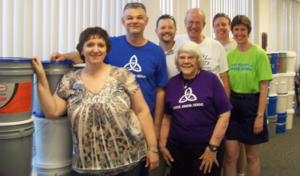 Good golly Miss Molly, you have never seen people get into action like these church people did! Previously sedentary folks became like friendly drill sergeants, rallying the troops. Quiet quilters began hosting moveable dinner parties for the workers and displaced townspeople. Giving went up as a common needs surfaced. It was a lovely, chaotic delight to behold!
In the end, of course, love was the answer. But first, there was a tornado.
What kind of leader are you? The kind your people need at this moment? Maybe it’s time for you to start praying…

