Six Steps to Getting Your Church Past Polarization

Six Steps to Getting Your Church Past Polarization

At a time when polarization seems to be at an all-time high, most churches are not able to bridge the gap.  Instead, they are caught up in divisiveness, too. This polarization limits the church’s ability to lead or to distinguish itself as a spiritual institution. That’s why I want to share six steps to getting your church past polarization.

These six steps are important to take. In some ways, churches now resemble the US House of Representatives more than the house of prayer that Jesus envisioned. It’s not that your church shouldn’t wrestle with important issues. By all means, it should.

But when the voice of the church is framed more by politics than ethics, or by who it stands against instead of the love of God that embraces all, this is bad news for your church and the community you serve.

The Lure of Polarization

We know we are supposed to love God, love others, and love ourselves.  We know we are supposed to turn the other cheek and do good to those who hate us. Yet we find that hard to do with fellow church folk, let alone the people “out there.”

Unconditional love is hard to muster when news headlines play on fear, outrage, and worst-case scenarios.  Or when social media feeds reinforce your perspective on the world. It takes true effort to get past these views of the world and believe that something else is even possible.

When churches try to speak to issues like the pandemic, immigration, or even school shootings from a political perspective, they get caught in either/or choices popularized by right- and left-wing media.  This creates a lose-lose situation with no room for nuanced disagreement.  Either/or choices are destined to polarize, and to pit people against each other.

I’d like to offer an alternative for getting your church past polarization. It comes from  prioritizing ethics over politics.

ethics over politics

Prioritize Ethics Over Politics

I suggest this 6-step process for ethical thinking.  It’s not perfect or complete, but it will give you a starting point.  United Methodists will recognize elements of the process as it engages the Wesleyan quadrilateral, the four sources by which we live out their faith.

Step 1 When it comes to thinking ethically, the first and most important step is to get the facts.  That means looking beyond Facebook memes and polarizing talking heads.  It means digging deeper to find out what’s really going on.  “Some moral issues create controversies simply because we do not bother to check the facts,” observe the authors of Thinking Ethically.

Step 2. Turn to the scriptures.  Discover the biblical stories or principles that might apply.  This means thinking deeply and widely about meta messages of the Bible.  Resist the temptation to pluck one or two scriptures out of context that seem to fit the situation.  Many of the ethical dilemmas we face today were never mentioned in scripture.  Similarly, the scriptures themselves were written over centuries in response to situations that are far from our post-modern context.

Step 3 Look to other commentaries or sources of your faith.  United Methodist will want to consult the Book of Discipline, the Social Principles, and the Book of Resolutions to see how other informed persons of faith have approached these issues.

Step 4 Look at the history of the issue.  How has it been dealt with in the past? What has worked?  What hasn’t?  As thinking persons of faith, we engage our faculties of reason.

Step 5  Engage in prayer.  A word of caution here.  I wouldn’t necessarily ask for specific answers to your specific questions; this prayer may lead to confusing our own solutions with God’s divine guidance.  Rather, I suggest praying for guidance and wisdom as you discern together.

Step 6 Engage in respectful, patient discussion about the resources at hand.  To do so, first decide on ground rules and boundaries, so that your discussions don’t become polarized or violent.  At this point, don’t try to come to final solutions or absolute positions.  Rather, keep an open mind.  Keep prayer present even in the discussion.  Over time, discuss possible ethics-based approaches to addressing the problem at hand.

Don’t worry if you don’t all come to the same conclusion.  You probably won’t.  That’s okay.  Here’s what you will have done:  you will have thought faithfully and ethically about the issues at hand.  This ethics-based process creates trust, loosens polarization, and increases your skill at diving deep as a community of faith.  It might even get you loving one another, differences and all.

In Creating a Culture of Renewal®, we empower church leaders to bring out the best in those who frustrate them the most.  Not an easy task. But it is doable.  


Copyright © 2021 rebekahsimonpeter.com, All Rights Reserved.

Do Small Churches Need to Embrace Technology?

Do Small Churches Need to Embrace Technology?

Do small churches need to embrace technology?  If so, how much? With the whole world moving online, small churches shouldn’t be left behind.  But many small churches are rural congregations with aging members.  How do you help them make the leap?

In this article I am going to share the top three ways your small church can embrace technology. Your congregation is important to your community, and your message is more relevant than ever before. Embracing technology, without breaking the bank, or overloading your people, is important.


Small Church Technology:  Avoid Too Much Too Fast

As you embrace technology, or add more tech, avoid making this one mistake:  doing too much too fast.  Small churches tend to be late adopters. They won’t be the first on the technology bandwagon. But they needn’t be the last. Avoid doing too much too fast or you’ll hit a wall of resistance.  Instead, start with what is most needed and go from there.

I suggest you start with these three steps for small churches to embrace technology.


Step One: Get Up to Date

The first step in embracing technology is to make sure your basic tech is working and functional. For instance, does your small church have a working phone with an up-to-date phone message?  Does the congregation own and use a computer? Is email set up?

I arrived at a small rural congregation in August of 1999 to find that the church was off the grid. The photocopier was on the fritz, the voicemail was disabled, the computer was iffy, and they had no email account.

Within the first month of my tenure, I ensured the basic technology was up and working. By the time December 31, 1999 came around, we were online enough to be worried by the Y2K scare. Several years later, the congregation was gifted a screen and overhead projection system.  I was concerned that the older generation wouldn’t like it. But they surprised me: they loved how large the words were; the enhanced visibility made singing louder and easier.

When it comes to technology, start with the basics before you expand. And I mean basics: a telephone, a photocopier, a computer, and an email account are basic. For many congregations the basics also include an overhead projection system.  Of course, if you don’t have indoor plumbing or electricity, you might want to start there!


Step Two: Get Connected to the Outside World

The second step in embracing technology is to get connected to the outside world.  After you’ve got the basics, expand to include a Facebook page, or a website. If you don’t have your own website, make sure your congregation is noted on regional or denominational websites with correct worship times and days, address, and pastor or congregational leader.

By the time I left the rural congregation I served, some seven years later, the congregation also had a working website.  Although Facebook didn’t exist at the time, when it came into being, I’m hopeful someone saw to it that a Facebook page was established.

pastor embraces technology


Step Three: Hybrid Worship

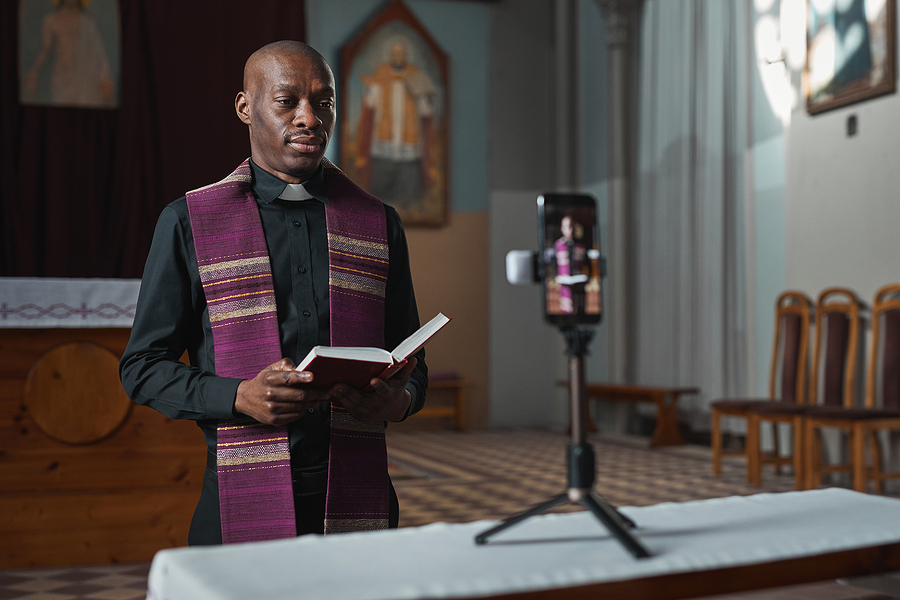
Make the move to bring your worship online.  You can do it with Facebook Live. That’s as simple as using a smartphone to capture what happens in worship.  When you do this, be sure to address the people who are watching, worshiping, and participating with you online.  Even if they watch later, they are still part of your congregation. Be sure to greet them. Include them in the message, the prayers, and the offering. Likely you’ll find your worship growing as you expand the ways people can participate.


Small Church Technology Do’s and Don’ts

Do make progress. You can go farther than you think you can. By incorporating technology and the accepting the learning curve that comes with it, you may be surprised how quickly you learn how to use the tools that are most helpful and necessary for your congregation.

Don’t assume that older people don’t want to embrace technology.  Many of them are meeting with kids and grandkids on weekly Zoom meetings, FaceTime visits, and the like. Also, don’t assume that every young person is constantly on their smartphone, or even has a smartphone.

Do use the technology you invest in for multiple purposes. A webcam is a great tool that can be used to record, livestream, or take worship to Zoom. This will allow greater participation for members that aren’t comfortable returning to church or can’t attend in person every week.

Don’t make tech decisions based solely on cost. Money that goes toward getting or upgrading outdated technology is money well spent. The benefits of buying quality equipment that will allow you to reach a larger community is unmatched.

Think of embracing technology as a journey, not an event.  Technology isn’t going away.  You can’t master it.  None of us can. But you also don’t have to resist the flow of it.

When it comes to technology, the point isn’t to be trendy.  Rather it’s to be connected in all the ways that are possible.  Just as the Bible reminds us that even feet can be beautiful as they carry the good news, so too can new technologies. They enable us to carry good news in fresh ways.

Not sure how to handle the technology reformation or other ways of moving people forward? Reach out here to stay connected. You don’t have to do it alone.


Copyright © 2021 rebekahsimonpeter.com, All Rights Reserved.
Machetes, Guns and the Hidden Message of Epiphany

Machetes, Guns and the Hidden Message of Epiphany

When a machete-bearing assailant broke into a private Hasidic home to “get” the Jews who were celebrating Chanukah there, his move was both horrific and ironic.  That the safety and merriment of a home could be violated by such hate is unthinkable. That it happened at Chanukah is incongruous.  Chanukah is at its core a holiday of religious freedom whose eight nights of light commemorate Jews’ ability to worship God in their own way—free and unfettered.  This terrorist served to heighten the awareness of our need for Chanukah.

In the Jewish pantheon of holidays, the Festival of Lights is relatively minor.  Yet it has taken on even greater importance in a Christmas-centric culture.  In light of this year’s increasing number of anti-Semitic incidents, it is sure to take on even greater significance.

When an armed assailant drew a gun at West Freeway Church and shot down two people on the Sunday after Christmas, his move was also horrific and ironic.  That the safety of sacred worship might be interrupted by gunfire is reprehensible.  That it took place directly after Communion is absurd. His violence reinforced our need of the Gospel, of the Kingdom.

Both acts of violence meant to snuff out something: a sense of belonging, safety, connection.  Undoubtedly, lives are forever shattered.  At the same time, something equally sacred, equally unshakable, is also taking hold.

Instead of highlighting the “otherness” of the victims, these horrific acts reinforced a further irony:  the inhumanity of the perpetrators. Their destructive, life-denying actions do not mirror who we strive to be.

The forces of darkness these men harnessed are the very ones that Advent laments and which Epiphany fully addresses. Rise of Skywalker (the latest Star Wars movie—which I swore I wouldn’t see but am ever so glad I did) shows the value of focused and intentional resistance to the forces of darkness.  Victory comes not from matching outrage with outrage, but by matching the calculated and cunning desire for power with a focused insistence on using The Force and its light. Rise of Skywalker showed that even the strongest proponents of light have seeds of darkness within them, and even the strongest proponents of evil can break free of its grip.

This Epiphany, we celebrate the Incarnation.  This ancient holiday celebrates that even in the midst of machetes, guns, and hate–God breaks through into our human experience.  All that is good and holy and divine are borne in the life, body, and witness of Jesus of Nazareth.

This year, Epiphany has a deeper, more surprising message for us. Just as God breaks through into human experience through Jesus, so too through us.  Made in the image of God, called to be Christ-like in every way, we too are designed to bear both humanity and divinity. To have a body is to have a soul.  To have a soul is to bear the incarnation of God, to be a hidden slice of the divine.

In the face of increasing public violence, and the inhumanity it reveals—it’s common to respond with either seething outrage or frozen immobilization.  I get it.  I have felt both.  I’m just not sure either of those ways moves us sustainably toward the kingdom.

But there is a third way.  It comes by tapping into the promise of Epiphany.  Together with Jesus, following his lead and direction, we can tap into our inner divinity.  We can dare to co-create miracles with God.  We can transform seething outrage into focused action and let frozen immobilization melt into collaboration and community.

I invite you to bring your Epiphany dreams for a new decade to our January course:  DARE to Dream Like Jesus.  Let your dreams take hold as you explore your authority, your agency and your ability to bring the impossible to life. Click here for more information.


Christmas and the Last-Minute Leader

Christmas and the Last-Minute Leader

If you are a last-minute leader, you’re not alone.  You’re not the only one putting finishing touches on a worship service, sermon, play, piece of music, bulletin or outreach effort.  In fact, you can be forgiven for thinking your timing is right in line with the theme of the season.  With no room at the inn, Mary and Joseph are ill-prepared for Mary to comfortably give birth to Jesus.  Much of Jesus’ early life, too, is spent on the fly avoiding Herod.

As Biblical as being last-minute maybe, there’s a cost for today’s church leader. We are in danger of missing the very spiritual qualities we are preparing to share with others.

Last-minute activity, done under pressure, activates the release of adrenaline. Once adrenaline is released, it gives us a heart-pounding rush, energizing the system. There’s a feel-good component to that. At the same time, it shuts down the part of the brain that is tuned in to the mood. And it messes with the heart’s rhythms, creating discordance instead of coherence. The ragged heart beat that results disconnects us from the people we love, unable to relax or connect in meaningful ways.

I remember one Christmas Eve in particular, where I had been scurrying around like the proverbial chicken with my head cut off. I had successfully managed one urgent matter, calmed down two anxious people, and counseled three lonely people. I felt very useful, but strangely empty. When all was said and done, I had many things I could check off the to-do list, but I had no sense of peace in my soul.

Here’s the thing: there will always be last-minute things we cannot control. There’s something about Christmas that seems to bring the unexpected to the forefront. At the same time, there are many things we can control. For instance, there are no surprises about when Christmas comes. Christmas Eve comes like clockwork on December 24. Christmas Day falls reliably on December 25. Advent is always the four weeks leading up to Christmas. We can plan for these holidays, folks.

Here are some last-minute recommendations for the last-minute leader.

First, congratulations on managing all the things that need your attention at this time of year; good job!   Give yourself some love; this is not an easy calling.

Second, consider all the people you will be serving this Christmas. It may well be the highlight of your year—a full sanctuary, new people coming in, beautiful music, people who know the stories and the words. Pray for these folks in joyful anticipation. Bless them. Open your heart to them.

Third, spend some time between Christmas and New Year relaxing. Getaway for at least a little bit. Give attention to your own spirit, your own family, and your own well-being. Play and rest. During this time, I like to reflect on the wins and losses of the previous year, to count my blessings, and write out my celebrations. Once Christmas is over, spend time on this most important of activities. It will help you set the stage for a powerful 2020.

Fourth, don’t wait til Fall 2020 to look up the dates of Thanksgiving, Advent, Christmas and New Year. Map them out now. Think through the timing of Christmas Eve, Christmas Day and Watch Night services, and surrounding Sundays. Make note of the lectionary readings. Begin to collect stories and let your imagination connect with the scriptures. Put your notes where you can easily find them next year. And then, breathe deep. After all, Lent is coming.


Is Your Advent Prayer Missing the Point?

Is Your Advent Prayer Missing the Point?

The Advent the liturgy instructs us to pray—solemnly, hopefully, deeply—is “Come, Lord Jesus, come.”  This hopeful prayer set against the backdrop of darkening days—both seasonally and politically —implies waiting with expectation.  Yet I can’t help but wonder if this prayer misses the point.

What are we waiting for?  We all know Jesus has already come.  While he was here, incarnate on earth, he already showed people how to do what he did. How to bring health to illness. How to bring light into darkness.  How to bring truth to an empire of crushing power.

Instead of waiting on Jesus to work through some heavenly redemption, perhaps Jesus is waiting on us to work some earthly miracles.

During Jesus’ life, he was very clear about sharing his power with his disciples and apostles.  He wanted them to be able to do the very things he did.  To heal the sick.  To cast out demons.  To feed the hungry.  To proclaim the Kingdom.  To expand the ranks with new apostles of peace.

If you are praying for Jesus to do something he has already taught you how to do, then maybe it’s time to take up some new prayers.

I’d like to suggest the following three prayers this Advent:

Pray the Apostle’s Prayer. “Lord, increase our faith.” (Luke 17:5) When the apostles prayed this, they weren’t asking to have more faith in Jesus, but to have more of the faith of Having that sort of faith is what it takes to do the things he did.  And to go beyond it.

Pray the Prayer of St. Francis. I love this prayer because it instructs me in exactly how to   be an apostle of peace, a force for good in the world.

Lord, make me an instrument of your peace
Where there is hatred, let me sow love
Where there is injury, pardon
Where there is doubt, faith
Where there is despair, hope
Where there is darkness, light
And where there is sadness, joy
O Divine Master, grant that I may
Not so much seek to be consoled as to console
To be understood, as to understand
To be loved, as to love
For it is in giving that we receive
And it’s in pardoning that we are pardoned
And it’s in dying that we are born to Eternal Life
Amen

Pray “I believe; help thou my unbelief.” (Mark 9:24) I pray this prayer when I find myself wavering in my ability to be courageous in the face of evil, or hopeful in the face of darkness.

Praying these prayers will align your life, thoughts, actions and soul with Jesus’ call to us:  to be apostles of peace, healing, comfort, and Kingdom.

There’s one more thing I invite you to do this Advent.  Register for the DARE to Dream Like Jesus course.   You will learn about Jesus’ big dream for the world, the DARE model of dreaming, and how to grow in the faith of Jesus to make a true difference.

Pray “I believe; help thou my unbelief.” (Mark 9:24) Share on X

Should Gender Matter in Christianity?

Should Gender Matter in Christianity?

When addressing Gender and Christianity, a particular example comes to mind.  Specifically the role of women in church leadership.  After telling wildly popular evangelical bible teacher Beth Moore to “go home,” influential fundamentalist preacher John MacArthur clarified his thoughts on women in church leadership. He warned that “empowering women makes weak men” and “weak men make everybody vulnerable to danger.”

Wait a second.  Studies around the world show that empowering women is the key to developing economies, family well-being, better nutrition, and equal rights.  So how could this move be anti-male, anti-social or anti-Christian?

When you take the long view of religious development, I believe MacArthur had it exactly backwards.  Rather than derail Christianity, the full participation of women in all aspects of Creation is the fulfillment of the Christian impulse. 

A look at Judaism reveals why.

Judaism is built on the power of distinctions.  The creation stories exemplify the distinctions between the first six days and the other days of the week; between the sun, moon and stars; between plants and animals; and between humans and God.  The evening prayer in Judaism plays on those themes by glorifying the distinctions between night and day, and between sleep and activity. Havdalah, the blessing that ends the Sabbath, lauds the differences between holy and secular, and between Sabbath and the rest of the days of the week.  Ancient Jewish prayers even prompt men to pray with thanksgiving that they were not made a woman, a gentile or a slave.  Distinctions matter in Judaism.

Christianity goes in a decidedly different direction. 

Rather than playing on distinctions and dualities, Paul has a vision of integration. “There is no longer Jew or Greek, there is no longer slave or free, there is no longer male and female; for all of you are one in Christ Jesus.” (Galatians 3:28) Indeed, women play a major role in the Gospels.

This theme of unity and integration is further celebrated in the New Testament. Consider the story of Pentecost.  When the Spirit comes, all hear a unifying message in their own language. This unity is celebrated as people share in a common life, a common purse, and a common purpose.  Finally, we see in Revelation 7:9-10 that all tribes, peoples and languages have a common trajectory—unity within the oneness of God.

So what’s with the stink about gender distinctions?  Truth be told, MacArthur isn’t the only one who forgets the integrative impulse in Christianity.  Mainline Christian churches have their own version of his call for strong women leaders to “go home.”  Women are called the “B word” and sent packing in more ways than one.

I wonder if the focus on gender isn’t indicative of deeper problems in the church. Like decline in worship, influence, and imagination.  Todd Anderson, a District Superintendent in the West Ohio Conference, told me, “The church is only in decline where the status quo is enforced.”  He should know.  Every District Superintendent is painfully aware of how the status quo stifles new life.  That’s why Todd is working across state lines, district lines, and conference lines to create new, experimental ministries. And they’re bearing fruit.

Decline is not a Christian value. The status quo is not a Christian value.  Women preaching, turning things upside down, is. That’s what lets new life in.

Interestingly even Judaism itself has moved toward integration.  While distinctions still matter, female clergy are beginning to be ordained in the orthodox world.  Even transgender clergy are being welcomed.

Bottom line:  if empowered women are threatening some men, perhaps those men need to deepen their own sense of self, rather than seek to bring women down a peg.