
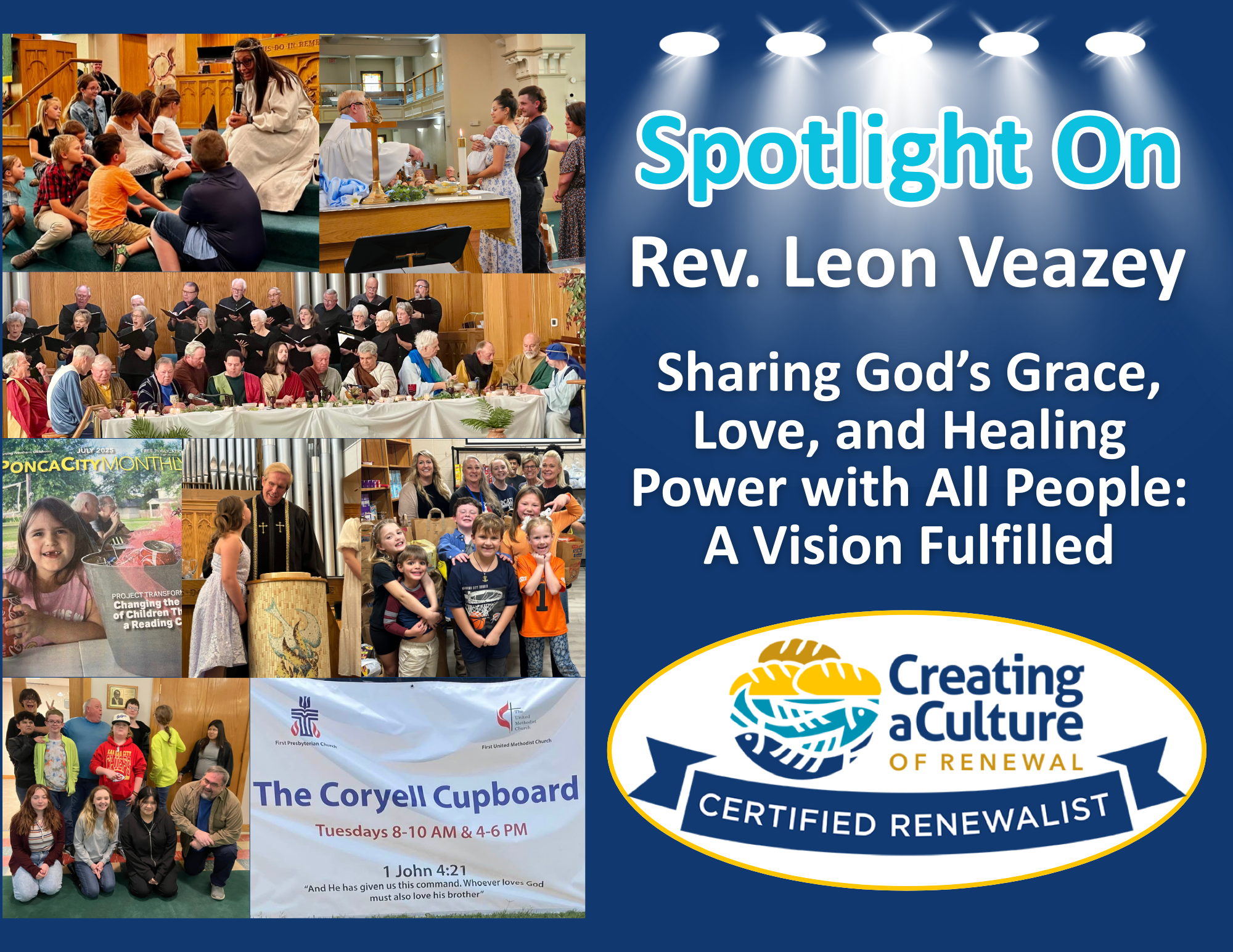
“Our vision is to be a body of believers in Jesus Christ who celebrate and share God’s grace, love, and healing power with all people”
What happens when a church dares to step beyond its comfort zone to truly embody grace, love, and healing for its entire community? For Certified Renewalist and Creating a Culture of Renewal® graduate Rev. Leon Veazey, this question became a spiritual calling. At First United Methodist Church of Ponca City, Oklahoma, working in ecumenical partnership with a neighboring Presbyterian congregation, Leon and his leadership team began to imagine a future where people of all backgrounds and economic realities are welcomed, supported, and empowered. Sharing “God’s grace, love, and healing power with all people” is truly coming to fruition in their community.
Through ministries like Coryell Cupboard and Project Transformation, this vision is now becoming reality—impacting not only the community, but the church itself. This blog is the third in our Spotlight on Certified Renewalists series, featuring graduates of Creating a Culture of Renewal® who are leading the way with bold, Spirit-led visions. As you’ll read in Leon’s story below, when a church dares to trust the Spirit’s leading, even the most unlikely partnerships can spark transformation that touches lives and renews the Body of Christ.
Sharing God’s Grace, Love, and Healing Power with All People
At Ponca City (OK) First United Methodist Church, and in our Ecumenical Partnership with the Presbyterian Church, we envision a community where people flourish through meaningful relationships, education, and resources. We imagine a community that doesn’t have a cycle of poverty and homelessness, where people who struggle with being under-served find meaningful relationships, education, and resources to elevate their state of living within the ministries of the church.
The vision expands assumptions about what is possible because it is humanly impossible for two churches with a retired upper-middle to upper-class white-collar demographic to connect with a population that is struggling to survive economically. Yet, we moved a 501c3 ministry, Coryell Cupboard, into our facility, and what began as 77 households being served each Tuesday with household cleaners, hygiene products, paper goods, diapers and wipes, and feminine care products has turned into 190 households per week. These are people who are in our facilities engaging in conversations, praying with, and building relationships with volunteers from our two churches. We have two individuals who are homeless who have become regular attenders of worship and Sunday School, and another young family with three children who are a regular part of our Wednesday night programs.
The vision is bigger than we are because we don’t have the capacity to meet all of the needs of our clientele in Coryell Cupboard, or to change our own hearts so that we become compatible with the culture of the people we are seeking to reach.
The vision scares us because none of us are comfortable with the emotional and mental messiness of many of the people we engage now through our current ministries. Furthermore, we have taken on being a host site for Project Transformation and will host an eight-week reading camp for 50 elementary kids from the under-resourced population of our community. We will be hosting six college students who were formerly AmeriCorps members before it was abruptly defunded by the current Presidential Administration. We are housing them and providing a paid Site Supervisor, a host of volunteers for reading tutoring, STEM classes, arts and music, recreation, field trips, and a couple of community outreach events. That’s scary, but we’re doing it!
Everything we are doing with Coryell Cupboard and Project Transformation is for the flourishing of the community rather than the survival of the institution. The people whose lives we are affecting, and whose lives are affecting us, are nowhere close to the demographic these two churches have always served. And I have been moved deeply to see how inspired our two congregations have become with these two ministry initiatives! People who pushed back at first are now at the front of the line to want to be identified with Coryell Cupboard and Project Transformation!
This reality would not have come to pass without a long and sometimes very difficult visioning process. For the first two years of our vision team’s endeavors, I was not sure we were accomplishing anything! Then things started to come together. I began to listen more to the people, hearing their dreams and hopes for the community. When I finally met them where they were at and let go of my own idea of a vision, we started “cooking with peanut oil!”
Connecting the Dots: Where Vision Meets Community Needs
Our vision involves recurring themes including education, poverty, maximum use of facilities and human resources, and building relationships with the spiritual but not religious populations of our community. When we began to realize that we have a host of retired and currently active educators, a Wednesday night meal ministry as a hub for connecting people with relational opportunities, and a substantial amount of space not currently used for ministries, we began to see a vision emerging. The emerging theme was utilizing our bent towards education in a state that now ranks 49th in reading and math levels for elementary age children, and the resources we have to empower children, adults, and families to flourish rather than struggle.
From that theme emerged two consistent pathways to make the most of these resources without reinventing the wheel. A few of us had limited experience with Project Transformation and envisioned it as Phase One of our Vision. Project Transformation began in Texas in the 1990’s utilizing AmeriCorps-trained volunteers to lead these eight-week reading camps for elementary students, and to help avert school drop-out trends and struggles with gaining and maintaining suitable and ample employment opportunities. With the facilities and personnel resources we have, and three area schools that qualify for the Project Transformation under-resourced population requirements, we realized this was a tool that made too much sense to ignore.
Another educational theme that continued to surface pertains to the Bridges Out of Poverty program, to which three of us had been introduced through three separate initial training events. This program educates churches, organizations, and communities about the cycles of poverty and the mindsets that prevent those cycles from breaking. Part of the program is implementing 15–20-week small groups to help under-resourced persons find pathways out of the poverty cycle. We realized that our Wednesday evening meal program, followed by Youth, Children, and Choir Ministries, was a perfect hub to which we could add the Bridges component of the 15–20-week small groups. This was part of the impetus for our decision to move the 501c3 Coryell Cupboard to our facilities to provide a network of people with whom to build relationships and eventually help find pathways to flourishing. Bridges Out of Poverty will be Phase Two of our vision.
Gaining Coryell Cupboard, adding three of our United Methodist Members to its Board and several to its volunteers, and seeing it grow by 150% in its reach, were unexpected wins that came from our vision so far.
Turning Vision into Action One Phase at a Time
In the beginning, we realized that this vision must be in phases. Our resources and capacity would be better applied to one focus at a time. So, we began with Phase One as our Project Transformation initiative. We began drafting with enthusiasm, even before we knew we would be accepted as one of only five Oklahoma sites in 2025. Two other churches in our region were applying, both of which are larger, and one of which has been a site before. Logic seemed to dictate that we were the lesser choice for selection. Yet, we still developed the plan and were elated when we were chosen.
We reached out to several other area churches to invite people to become part of the vision and help us build a team. Four of those churches started participating immediately, and recently two others have come on board. One of the churches was to provide intern dormitories for our AmeriCorps Members, but when they found out one of them was non-binary, they decided to bail. This was a late decision, and housing had to be acquired. At about the same time, the current Presidential Administration ended funding of AmeriCorps, and the members were released from their contracts and lost their scholarships.
While these setbacks seemed daunting, our team has held together and pushed on with resolve. We are hosting the six remaining former AmeriCorps Members at the church parsonage, which is perfect for their needs, and the pastor is going to camp out on the river in a travel trailer for two months. The Oklahoma Conference of the United Methodist Church has stepped up to ensure that the college students, formerly AmeriCorps Members, are going to be taken care of. We have had people step up, businesses, and organizations who have said they will fund the scholarships that were lost by these college students if necessary.
Alignment began with the Vision Team coming together in solidarity on the vision and its first phase. We visited Sunday School Classes, committees, and spoke to the congregation about this. The other United Methodist and Presbyterian Churches did the same. The buy-in has been phenomenal. At times, I wonder how this has all come together so fluidly, but I remember that getting the team to come to a shared vision wasn’t a quick process. I also remember that we are building a “Jesus-size Dream,” and the empowerment of our agency is divine and not human. I’ve even started hearing United Methodists speaking of the supernatural way that this has begun to take shape.
Becoming a Church for the Whole Community
The culture shift around me in the past three years has been phenomenal. For so long, I didn’t see the kind of results I wanted, but when it started coming together, the shift seemed almost abrupt. I have seen the church I pastor come from a very inwardly focused congregation to the beginnings of an outwardly moving congregation with a passion to effect change in our community! We now have a host of people from our community who are non-church people, and who would have never imagined entering our building, coming in weekly, and engaging in dialogue, collaboration, and relational bonding with people not even close to the same demographic. Some of them ask for prayer, take Bibles, ask about programs of the churches, and a few have even started attending. We have a long way to go with being as hospitable on Sunday morning as we seem to be on Tuesdays! Most of our people are awkward and still stiff and uncomfortable with the presence of a drastically different demographic present in our worship and discipleship community. While this weighs heavily on my heart, I am encouraged that we are starting to dialogue about this in our Ecumenical Partnership meetings with the Presbyterian and United Methodist representatives.
One of the things I have done in this shift is to more often preach from the gospel passages of the lectionary, with intentional presentation of the Jesus who leads us into the margins and forbidden places of society to collaborate with and serve with “the least of these” in building the Kingdom of Heaven on earth. I have focused on Jesus and allowed the Holy Spirit to embolden me to preach the truth about where Jesus is leading us.
I am not going to stray from the leadership of the Holy Spirit and the record of justice for all in scripture to be “comfortable” in worship services. I remain confident with resolve in the apostolic ministry Christ has entrusted to me! The culture of my leadership has changed! For that, I am deeply grateful to God and Creating a Culture of Renewal®.
Are You Ready to Lead a Bold Vision in Your Own Ministry?
Rev. Leon Veazey’s story shows what can happen when leaders let go of what’s comfortable and follow the Holy Spirit into the margins. What began as a long and uncertain process has become a vibrant, growing, community-based ministry that reflects the heart of the Gospel.
You can do the same.
Join us for our upcoming interactive seminar: How Christian Ministries are Achieving Success.
In this free 90-minute session, you’ll learn what’s working for leaders like Leon and discover how Creating a Culture of Renewal® can help you cast your own Jesus-like dream, gain buy-in, and lead meaningful change.
Register here and start the journey toward your own vision fulfilled!
Copyright © 2025 rebekahsimonpeter.com. All Rights Reserved.




0 Comments
Trackbacks/Pingbacks