Vision Impossible: CCR Participants Get Results

Vision Impossible: CCR Participants Get Results

This week, I’m honored to share Rev. Therese Lehman’s experiences surrounding crafting and honing a vision with her congregation.

As Therese reminds us, crafting a vision isn’t easy, but the results are well worth the struggle. And, by using her Creating a Culture of Renewal® learnings, and gaining confidence in her leadership skills, she was able to hone her vision into one that was truly a Jesus-like dream.

And, with the help of God, not at all “impossible”!


A Good Leader Challenges

Crafting a vision is hard work, takes time, takes active listening to many people and involves a lot of prayer. Trying to get a group of 12 people to come to a consensus around that vision is impossible without understanding yourself and others, and having leadership skills such as spirituality, conflict productivity, listening, confidence and boldness.

The Walnut Street UMC Leadership/Visioning Team had read and discussed “Dream Like Jesus” over the previous14 months.  We had some good discussions and completed all the exercises. One person came up with something and everyone was eager to agree to implement it so we could move on.  But it didn’t feel right to me.

The first thing I learned and put into action was that a good leader asks questions and challenges.  I didn’t do that right away because of my fears, but gradually I began some push back as to whether the vision, “To be Christ in our families, church, community and the world and to bring others into God’s family” was really a vision or a mission.  I boldly shared and asked questions, stepping out of my comfort zone by speaking up.  After further prayer, thought and discussion over the next few months, the vision changed to “No more homelessness or hunger in Chillicothe.”  This was more of a Jesus-sized vision but how would we get buy-in from the congregation and what goals would we set up?  I found myself “kicking the vision down the road” for another couple of months, fearing making a decision.

I learned through my DiSC® profile that I prefer to “seek closure” instead of being more open.  By postponing a decision on a vision, I wasn’t doing either.  I needed to be “more intentional about exploring new ideas to create a vision” and “be more adventurous and voice my ideas.”


Prioritizing the Big Picture

I attended a couple of city council meetings where the issue of homelessness was being discussed.  As I listened to the speakers, I began to hear a word other than homelessness – poverty.  Many of Chillicothe’s residents live well below the poverty line and a factory that employees over 800 people will be closing at the end of this year.  What if we began to address this bigger issue?  It scared me!  I wanted to hold back and be very cautious, but Creating a Culture of Renewal® had taught me that I should be adventurous, more open, prioritize the big picture, and speak out.

At the next Leadership/Vision meeting, I confidently and boldly proposed a new vision, “Poverty-free Chillicothe.”  It fulfilled all the elements of a Jesus-like dream and was bold!  I was totally surprised by the response. There was so much discussion, and everyone present spoke out, which did not always happen.  I was amazed that there was lots of push back and everyone was alive!!! It was wonderful!!  I realized it was what had been missing in our work together.  People began to explore some of the implications of the word “poverty” and how this vision was a challenge to our whole community!  This is what we needed.


Vision Impossible? NOT!

I am now realizing that creating a vision isn’t so much about achieving a successful result, as it is about coming together around a challenge in the community and discovering together the steps toward a solution.  This vision will have many action steps for the future, but we can begin with education about poverty both in our church and in our community.  Then we can discover what areas of poverty we would like to act upon.

At the end of our discussion, I knew I needed to give certain people time to process the new information and challenge others to come up with ideas on possible action steps.  I challenged everyone to take this vision and share it with family, friends and co-workers, both inside and outside the church.  They are to bring their feedback to our next meeting. I am excited to hear what people have to share.  I will be practicing active listening during this meeting more than talking!

The excitement and chatter after the meeting indicated that my new approach in leadership had sparked something.  I am now excited to take this vision further and begin testing assumptions and crafting action steps and goals with the team.  I want to involve the congregation and the community into looking into the deeper problem of poverty and discover how we can become poverty-free – because it is possible with God.


Therese’s vision of a poverty-free community initially did seem like a “vision impossible” but she knew in her heart that everything is possible with God.  And Creating a Culture of Renewal®’s proven leadership training is all about co-creating miracles with God and envisioning Jesus-sized dreams.

Crafting a vision isn’t always a simple task, but Therese tackled it with support from her Creating a Culture of Renewal® colleagues and her strengthened leadership skills. I feel confident that her vision will one day become reality.

Having trouble crafting your own Jesus-sized vision? Or have that vision, but need the skills to truly implement it? Creating a Culture of Renewal® is a proven and effective clergy leadership program that can bring about real change to your leadership, your congregation, and your community, too. I encourage you to take advantage of our free interactive seminar, How Christian Ministries are Achieving Success to learn more. Last Minute registration ends for Creating a Culture of Renewal® on September 8th, so you’ll want to take advantage of a free seminar today!


Copyright © 2025 rebekahsimonpeter.com.  All Rights Reserved.

Laser Focus Your Vision Statement: CCR Participants Get Results

Laser Focus Your Vision Statement: CCR Participants Get Results


In recent blogs we talked about Creating a Culture of Renewal® graduates, but for the next couple of weeks, I’m honored to share some profound experiences from current Creating a Culture of Renewal® participants.

Experiences that led to positive, life-changing results that likely wouldn’t have occurred without the leadership journey that is Creating a Culture of Renewal®.

I offer these testimonials with the hope that you’ll find them helpful in your own work with your congregations and communities.

This week, we’re looking at how Pastrix Carmen Daugherty crafted a Vision Statement that opened up their church community to those who might have been unsure of their welcome, assuring them a safe space to gather. Carmen’s experience can help you expand your vision, give you renewed belief in your leadership skills, and open your eyes to the possibility of your leadership becoming one that truly co-creates miracles with God.


Laser Focus

Creating a Culture of Renewal® (CCR) helped me use our Mission Statement that predated CCR to craft a laser focused Vision Statement for our programs.  This Vision Statement compliments the Mission Statement; it is easy to remember, and easy for members to repeat as compared to the lengthy Mission Statement.

Our working Mission Statement is “We are the Kaleidoscope. Inspired by the vast wealth of human diversity, we seek to reclaim our trust in Love by gathering in intersectional community to explore the sacredness of all lives, voices and stories.”  It is a beautiful mission statement, but it did not have the two qualities we needed: specificity and being memorable.  Using the tools I acquired in CCR I crafted this Vision Statement: “Kaleidoscope provides Safe, Sober, Social spaces for queer people of all ages to gather in community.”


A Jesus-Like Dream

The new Vision Statement contains the five elements of a Jesus-like dream, which Rebekah writes about in her book, “Dream Like Jesus”. It begins with the assumption that we will achieve creating a third-space for the LGBTQIA+ community.  A third-space (that does not include a bar) does not exist in Indianapolis so the Dream is way bigger than we are.  The Vision terrifies me because it is big and bold and I do not want to fail.  The Vision has inspired and unified our members and the third-space for LGBTQIA+ people is an example of the expansion and flourishing of the Kin-dom.

This Vision Statement has been a game changer.  When our members tell others about Kaleidoscope or are asked what Kaleidoscope does, they are quick to share our Vision Statement.  It has also helped members feel more confident volunteering at public events which allows more people to participate.  This continuity also keeps our message consistent in the community.

A fear that could easily have derailed me from starting Kaleidoscope as a ministry of the church was the negative reputation the church has in the LGBTQIA+ community and with younger generations.  In addition, starting Kaleidoscope could have jeopardized my future ordination as it was previously against the Book of Discipline to affirm “practicing” LGBTQIA+ people in leadership, marriage, or as clergy.  Our Mission Statement while beautiful was also “safe” for the church setting where we started because it did not mention LGBTQIA+ specifically.  Intersectional community could be anyone.  While this served us well in the beginning, the recent changes in the organization required a laser focused Vision to keep everyone moving in the same direction.

An example of our Vision at work would be when a member approached us after the election and wanted Kaleidoscope to organize a protest.  Obviously, we knew that this was wrought with potential problems for our 501(c)3 status, but there was also a lot of energy from the members surrounding this idea and they did not care about our nonprofit status.  Fortunately, we were able to point to our Vision statement and explain that while we encourage people to participate in protests, organizing them does not align with our Mission or Vision statement.  We told the members if they wanted to organize a protest, they could invite Kaleidoscope members, but that we would not be organizing one.

Our new Vision Statement has dramatically enhanced our ability to plan, organize, and resource our current programs (ministries).


Pastrix Carmen used the resources that were made available to them throughout their Creating a Culture of Renewal® journey to craft a Vision Statement that made a real, profound, and life-altering difference in their church and community.

Creating a Culture of Renewal® is a proven and effective clergy leadership program that can bring about real change to your leadership, your congregation, and your community, too. I encourage you to take advantage of our free interactive seminar, How Christian Ministries are Achieving Success to learn more. Last Minute registration ends for Creating a Culture of Renewal® on September 8th, so you’ll want to take advantage of a free seminar and register today!


Copyright © 2025 rebekahsimonpeter.com.  All Rights Reserved.

Love and Christian Actions: A Vision Fulfilled

Love and Christian Actions: A Vision Fulfilled


Leadership can be demanding. Personalities don’t always mesh. Conflict and confusion, even hurt feelings, can result from minor disagreements.

But Pastor Peter Choi was committed to overcoming obstacles, both due to his own leadership style and to the styles of others. Because he and his congregation working together to serve the greater community through love and Christian actions was a vision that he was determined to see come to fruition.

In this week’s spotlight, we’re sharing Peter’s story of how he and his team were able to bring about vital, positive change in both the community and in how they worked together.


Serving through Love and Christian Actions

Participating in the Creating a Culture of Renewal® program gave me a deeper understanding of our church leadership—and of myself. Using the DiSC® assessment, I was able to see how different leadership styles shape how people respond to ministry, decisions, and change.

Conflict is inevitable in ministry. Whether we like it or not, it’s always present when working with people. In the past, I’ve felt uncertainty when people disagreed with plans or pushed back against new ideas. But now, instead of reacting with uncertainty or anxiety, I’ve learned to respond with understanding. Each person brings a different style, a different story. Whether they support or oppose our efforts, I remind myself they are still my brothers and sisters in Christ. That truth has brought me surprising peace and helped me work more effectively with others to craft our vision to serve our community through love and Christian Actions.

We see a future for our community filled with Christ’s love, where people share lives, encourage one another, and find companionship. To achieve this, we actively engage in our ministry programs, serving and encouraging our community through various initiatives.

To fulfill this vision, we first focus on our spiritual growth. We offer spirit-filled worship services, numerous Sunday schools for all ages, weekday morning devotion, and Bible studies to help our spiritual growth. Additionally, we have significantly updated our facility to serve our church members and the community. One of the changes is the establishment of a warm and modern-style church café, which serves as a convenient meeting and fellowship place throughout the week. Furthermore, we organize regular lunch fellowship events for our community members monthly.

We expanded our food pantry ministry to include both daytime and night shifts. This expansion allows us to serve those who may not be able to come during the day due to their work commitments. Through God’s grace and the unwavering commitment of our church, we were able to purchase a food truck and establish a mobile food pantry in our community. We have over 40 families relying on our food pantry each week.

The success of this wonderful God’s ministry is a testament to the power of teamwork. Numerous volunteers, including both church members and community volunteers, work closely together as a united front. Their collective efforts have made a positive impact on both our church ministry and the broader community.


Working Together and Listening to Others

When we formulated our vision statement, we carefully considered both biblical and cultural factors. This was crucial for us to work collaboratively and to invite everyone to be a part of this process. This rationale inadvertently included all church members, as I had to intentionally consider their biblical and cultural backgrounds, which streamlined our vision alignment process.

As 1 Corinthians 9:19-23 emphasizes, it is commendable to consider others’ perspectives and circumstances. While we may not always have the answers to their differing viewpoints, I have found that they appreciate our willingness to listen and care for them. This process was essential and has yielded significant positive outcomes. We believe that this is necessary for our community, and it aligns with God’s desire for us to serve our community by providing essential ministry projects and programs that bless non-believers.

Through prayer and spiritual growth, the Lord had prepared me and our leaders to face conflicts, meet emotionally sensitive individuals, and find comfort in the affirmation of God’s presence. Ultimately, I remain at peace regardless of the obstacles I encounter in my ministry.


Collaborating with Community

Once we created the vision, it took months to build alignment for it. We engaged in extensive sharing, discussion, and listening to ensure everyone was on the same page. We also dedicated time to praying together for God’s presence to guide our ministry vision and goals.

For almost a month, I intentionally shared this vision in my sermons, explaining its significance and the steps we need to take to fulfill God’s plan for our ministries. To reach diverse generations within the community, we also included young college students in our vision team. This provided an excellent opportunity for our congregation to grasp God’s will and understand the reason behind our focus on this divine vision in our ministry.

One of the challenges we faced was finding volunteers who were willing to dedicate themselves to executing the vision together. It was particularly difficult to find the right person in the right place. However, we didn’t give up; we kept trying and praying for God’s guidance. We also witnessed the Lord’s daily addition of His people to our church ministry. By God’s grace and the prayers of many church members, we continue to receive new visitors and members to bless God’s ministry at Fishersville United Methodist Church. We excitedly look forward to the future of our ministry and the plan that God has for us.

We’ve experienced many blessings from God through our ministry as we engage with the community.


Through the Creating a Culture of Renewal® program, I have personally grown as I had numerous opportunities to reflect on my own challenges and spiritual barriers. I prayed for God’s guidance and encouragement, and I am experiencing this growth in my ministry setting. For instance, in the past, I’d get frustrated when I didn’t have enough support. I can now move on, focus on my responsibilities, and listen to what church members have to say more closely. I have developed greater empathy and compassion to help us all grow together to do ministry as a team.

I am grateful for this opportunity to grow and serve God’s church in His way. And, working together, we’ve truly served through love and Christian actions throughout our community. I am also humbled and deeply grateful to Rebekah and her staff for the opportunity to participate Creating a Culture of Renewal. I am also thankful for the wonderful support from FUMC members and the Virginia Annual Conference. God’s grace has been instrumental in all of these blessings. 


Our Call to Serve with Love

As Rev. Choi’s vision took shape, he became more and more dedicated to the call to serve with love, despite any stumbling blocks he encountered along the way. And serve he did, feeding the hungry in his community, day and night on a weekly basis.

We’re all called to serve as his church and community did, but the obstacles before us sometimes just seem insurmountable.

That’s where Creating a Culture of Renewal®, my proven and effective clergy leadership program, comes in. We offer a free interactive seminar, How Christian Ministries are Achieving Success, during which you’ll learn why Peter Choi credits his journey through this empowering program with much of the success of his leadership and vision.

Register here and start the journey toward your own vision fulfilled!


Copyright © 2025 rebekahsimonpeter.com.  All Rights Reserved.

Growing Peace: A Vision Fulfilled

Growing Peace: A Vision Fulfilled

When a small church dares to dream beyond its size, age, and limitations, remarkable things can happen. At St. James United Methodist Church in Missouri, a bold vision is taking root—literally. Faced with food insecurity, community division, and the absence of shared ministry among local churches, Certified Renewalist Rev. Alecia Fischer envisioned a Peace Garden that would nourish not just bodies, but relationships and hope. Through Alecia’s leadership her vision of Growing Peace: A Community Garden for Transformation began to blossom.

Born from a desire to unite a fragmented community, the Peace Garden is more than a patch of vegetables—it’s a ministry of presence, healing, and harmony. There’s no shortage of reasons Alecia’s dream might have stalled: fear of failure, lack of experience, an aging congregation, or financial uncertainty. But what mattered more was the Spirit’s call to act.

As you’ll see below, Alecia’s vision, and volunteers from both St James UMC and the community, show how Kingdom transformation is possible when people say yes to a Jesus-sized dream—no matter the obstacles. Growing peace is never easy, but it’s always worth it.


The Vision of Growing Peace Takes Root

There are several rationales for our vision of a Peace Garden in St James, Missouri.

  • The Church owns an empty lot, an open field maintained by church members.
  • There used to be a community garden many decades ago which was replaced when the community center/senior center was built.
  • Two schools are across the road from the church/vacant lot.
  • Our church just installed an emergency food pantry outside on the edge of this lot and discovered that it is used all the time. In fact, all the emergency food pantries in town are used daily.  There is a need for food in our community.
  • The Church wants to make a difference in the community around them. St James has a homeless problem, a drug problem and other issues that members of the Church want to help address.

People became excited about the possibilities of helping change the community of St James with the peace garden.

Challenges or pushbacks I received while gaining buy-in included: the loss of the empty lot/field, the cost of the project, the hours and people needed to put forth and maintain the project, and what would happen if it was neglected?  How I navigated and overcame those questions, with research on grant money available from various sources, conversations with school, church and city administrators, conversations with garden club members, and conversations with the people that administrated the former city garden.  I presented those conversations to the vision team and communicated the vision over and over in all of our communication.

The unanticipated wins with gaining buy-in were that even those who didn’t like gardening were excited.  People started thinking beyond church members who were excited to be a part of the visioning team and being a part of the ministry.


Vision Takes a Village

The community of St James will be transformed to be more peaceful, less violent, and experience less food scarcity.  People will treat each other like loving neighbors and not enemies.  This ministry will fulfill our denomination’s vision of Making Disciples for transformation of the world and as the vision is fulfilled it would transform our little corner of the world.

We started by thinking about a huge celebration to kick off the vision of the Peace Garden; everybody loves a party.  Then we thought and talked about all the steps that it would take to get to that party.  As we progressed through the steps, the big bold vision started to become more concrete and more of a reality than just a dream.

The community of people that were involved with the vision, beside the team, included the church trustees who are in charge of the property, the council that approves church ministries, those willing to serve on the vision team, community members who would be part of making this dream a reality, city, church and school officials, community businesses, grant programs and others in the community who were excited by the Peace Garden.

Feedback can be a blessing and a curse.  It was nice to hear the positive feedback, that we were on the right dream for the community. The negative feedback helped us to look at other opportunities that we might have missed or overlooked.  Sometimes the feedback came from professionals that were more knowledgeable about certain areas than we were.  The feedback helped to improve what we thought was possible and that at the same time was bigger than us.

One example was the condition of the soil on that property, so raised beds were agreed upon as better gardening spots.  Another feedback was on how to get water in that area for watering plants and vegetables.  Instead of running hoses across the road, installing a pipe system that would have a faucet on the property was suggested.


The Big Win is Peace

The culture is shifting at St James UMC.  Three years ago, I would have described the Church culture as fearful, inward focused, full of disciples but not apostles.  Now the church is less fearful, more willing to go on faith and trust.  They are focusing more on outreach, mission and reaching the community for the Kingdom.  I have seen an increase in their spirituality and more involvement in the Means of Grace, (worship, bible reading, prayer, small groups, etc.)

I also have experienced renewal as the congregation shifts toward renewal.  I am less fearful, bolder in adapting new things, willing to gently push them towards exciting new Jesus-like dreams.

Through Creating a Cultural of Renewal®, I have become aware of my DiSC® style and how that motivates me as a leader, and how to communicate better to other DiSC styles for the advancement of the kingdom.  We have seen a growth in membership, bible studies, participation in more outreach ministries, financial stability and in general more happiness for me and the church.

Blessings on this journey have been the connections that I have made across the Creating a Culture of Renewal community and the connections that I have made within my church are now stronger, healthier relationships.  A big win was that we did not take a vote, whether to remain in the United Methodist church.  Through peaceful conversations we were able to love each other and stay in relationship with one another despite our differences.  Three years ago, that would not have happened.

Neither would the miracle of the Peace Garden.


Help Miracles Grow in Your Ministry

Like Rev. Alecia Fischer, you’ll probably have to scale a few obstacles to make your vision a reality. But Alecia’s story reminds us that pairing Creating a Culture of Renewal® with a Jesus-like dream can help clear the path for miracles to flourish.

Learn more by joining us us for our upcoming free interactive seminar: How Christian Ministries are Achieving Success. In this empowering 90-minute session, you’ll learn what’s working for leaders like Alecia and discover how Creating a Culture of Renewal® can help you cast your own Jesus-like dream, and bring about real, meaningful change.

Register here and start the journey toward your own vision fulfilled!


Copyright © 2025 rebekahsimonpeter.com.  All Rights Reserved.

Sharing God’s Grace with All People: A Vision Fulfilled

Sharing God’s Grace with All People: A Vision Fulfilled

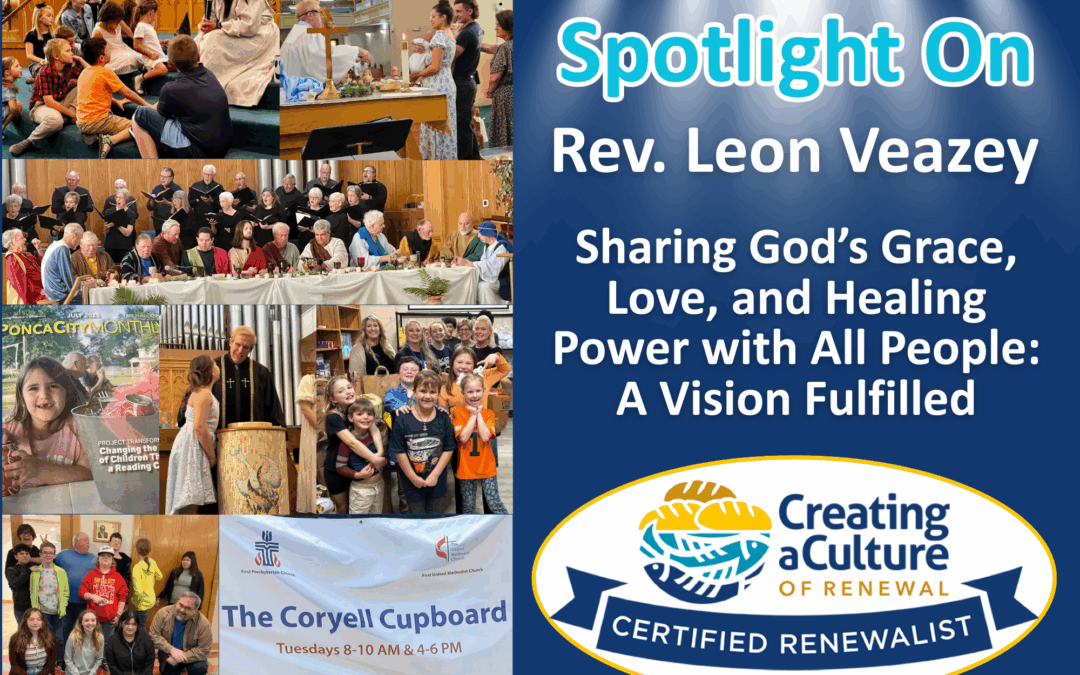
“Our vision is to be a body of believers in Jesus Christ who celebrate and share God’s grace, love, and healing power with all people”

What happens when a church dares to step beyond its comfort zone to truly embody grace, love, and healing for its entire community? For Certified Renewalist and Creating a Culture of Renewal® graduate Rev. Leon Veazey, this question became a spiritual calling. At First United Methodist Church of Ponca City, Oklahoma, working in ecumenical partnership with a neighboring Presbyterian congregation, Leon and his leadership team began to imagine a future where people of all backgrounds and economic realities are welcomed, supported, and empowered. Sharing “God’s grace, love, and healing power with all people” is truly coming to fruition in their community.

Through ministries like Coryell Cupboard and Project Transformation, this vision is now becoming reality—impacting not only the community, but the church itself. This blog is the third in our Spotlight on Certified Renewalists series, featuring graduates of Creating a Culture of Renewal® who are leading the way with bold, Spirit-led visions. As you’ll read in Leon’s story below, when a church dares to trust the Spirit’s leading, even the most unlikely partnerships can spark transformation that touches lives and renews the Body of Christ.


Sharing God’s Grace, Love, and Healing Power with All People

At Ponca City (OK) First United Methodist Church, and in our Ecumenical Partnership with the Presbyterian Church, we envision a community where people flourish through meaningful relationships, education, and resources. We imagine a community that doesn’t have a cycle of poverty and homelessness, where people who struggle with being under-served find meaningful relationships, education, and resources to elevate their state of living within the ministries of the church.

The vision expands assumptions about what is possible because it is humanly impossible for two churches with a retired upper-middle to upper-class white-collar demographic to connect with a population that is struggling to survive economically. Yet, we moved a 501c3 ministry, Coryell Cupboard, into our facility, and what began as 77 households being served each Tuesday with household cleaners, hygiene products, paper goods, diapers and wipes, and feminine care products has turned into 190 households per week. These are people who are in our facilities engaging in conversations, praying with, and building relationships with volunteers from our two churches. We have two individuals who are homeless who have become regular attenders of worship and Sunday School, and another young family with three children who are a regular part of our Wednesday night programs.

The vision is bigger than we are because we don’t have the capacity to meet all of the needs of our clientele in Coryell Cupboard, or to change our own hearts so that we become compatible with the culture of the people we are seeking to reach.

The vision scares us because none of us are comfortable with the emotional and mental messiness of many of the people we engage now through our current ministries. Furthermore, we have taken on being a host site for Project Transformation and will host an eight-week reading camp for 50 elementary kids from the under-resourced population of our community. We will be hosting six college students who were formerly AmeriCorps members before it was abruptly defunded by the current Presidential Administration. We are housing them and providing a paid Site Supervisor, a host of volunteers for reading tutoring, STEM classes, arts and music, recreation, field trips, and a couple of community outreach events. That’s scary, but we’re doing it!

Everything we are doing with Coryell Cupboard and Project Transformation is for the flourishing of the community rather than the survival of the institution. The people whose lives we are affecting, and whose lives are affecting us, are nowhere close to the demographic these two churches have always served. And I have been moved deeply to see how inspired our two congregations have become with these two ministry initiatives! People who pushed back at first are now at the front of the line to want to be identified with Coryell Cupboard and Project Transformation!

This reality would not have come to pass without a long and sometimes very difficult visioning process. For the first two years of our vision team’s endeavors, I was not sure we were accomplishing anything! Then things started to come together. I began to listen more to the people, hearing their dreams and hopes for the community. When I finally met them where they were at and let go of my own idea of a vision, we started “cooking with peanut oil!”


Connecting the Dots: Where Vision Meets Community Needs

Our vision involves recurring themes including education, poverty, maximum use of facilities and human resources, and building relationships with the spiritual but not religious populations of our community. When we began to realize that we have a host of retired and currently active educators, a Wednesday night meal ministry as a hub for connecting people with relational opportunities, and a substantial amount of space not currently used for ministries, we began to see a vision emerging. The emerging theme was utilizing our bent towards education in a state that now ranks 49th in reading and math levels for elementary age children, and the resources we have to empower children, adults, and families to flourish rather than struggle.

From that theme emerged two consistent pathways to make the most of these resources without reinventing the wheel. A few of us had limited experience with Project Transformation and envisioned it as Phase One of our Vision. Project Transformation began in Texas in the 1990’s utilizing AmeriCorps-trained volunteers to lead these eight-week reading camps for elementary students, and to help avert school drop-out trends and struggles with gaining and maintaining suitable and ample employment opportunities. With the facilities and personnel resources we have, and three area schools that qualify for the Project Transformation under-resourced population requirements, we realized this was a tool that made too much sense to ignore.

Another educational theme that continued to surface pertains to the Bridges Out of Poverty program, to which three of us had been introduced through three separate initial training events. This program educates churches, organizations, and communities about the cycles of poverty and the mindsets that prevent those cycles from breaking. Part of the program is implementing 15–20-week small groups to help under-resourced persons find pathways out of the poverty cycle. We realized that our Wednesday evening meal program, followed by Youth, Children, and Choir Ministries, was a perfect hub to which we could add the Bridges component of the 15–20-week small groups. This was part of the impetus for our decision to move the 501c3 Coryell Cupboard to our facilities to provide a network of people with whom to build relationships and eventually help find pathways to flourishing. Bridges Out of Poverty will be Phase Two of our vision.

Gaining Coryell Cupboard, adding three of our United Methodist Members to its Board and several to its volunteers, and seeing it grow by 150% in its reach, were unexpected wins that came from our vision so far.


Turning Vision into Action One Phase at a Time

In the beginning, we realized that this vision must be in phases. Our resources and capacity would be better applied to one focus at a time. So, we began with Phase One as our Project Transformation initiative. We began drafting with enthusiasm, even before we knew we would be accepted as one of only five Oklahoma sites in 2025. Two other churches in our region were applying, both of which are larger, and one of which has been a site before. Logic seemed to dictate that we were the lesser choice for selection. Yet, we still developed the plan and were elated when we were chosen.

We reached out to several other area churches to invite people to become part of the vision and help us build a team. Four of those churches started participating immediately, and recently two others have come on board. One of the churches was to provide intern dormitories for our AmeriCorps Members, but when they found out one of them was non-binary, they decided to bail. This was a late decision, and housing had to be acquired. At about the same time, the current Presidential Administration ended funding of AmeriCorps, and the members were released from their contracts and lost their scholarships.

While these setbacks seemed daunting, our team has held together and pushed on with resolve. We are hosting the six remaining former AmeriCorps Members at the church parsonage, which is perfect for their needs, and the pastor is going to camp out on the river in a travel trailer for two months. The Oklahoma Conference of the United Methodist Church has stepped up to ensure that the college students, formerly AmeriCorps Members, are going to be taken care of. We have had people step up, businesses, and organizations who have said they will fund the scholarships that were lost by these college students if necessary.

Alignment began with the Vision Team coming together in solidarity on the vision and its first phase. We visited Sunday School Classes, committees, and spoke to the congregation about this. The other United Methodist and Presbyterian Churches did the same. The buy-in has been phenomenal. At times, I wonder how this has all come together so fluidly, but I remember that getting the team to come to a shared vision wasn’t a quick process. I also remember that we are building a “Jesus-size Dream,” and the empowerment of our agency is divine and not human. I’ve even started hearing United Methodists speaking of the supernatural way that this has begun to take shape.


Becoming a Church for the Whole Community

The culture shift around me in the past three years has been phenomenal. For so long, I didn’t see the kind of results I wanted, but when it started coming together, the shift seemed almost abrupt. I have seen the church I pastor come from a very inwardly focused congregation to the beginnings of an outwardly moving congregation with a passion to effect change in our community! We now have a host of people from our community who are non-church people, and who would have never imagined entering our building, coming in weekly, and engaging in dialogue, collaboration, and relational bonding with people not even close to the same demographic. Some of them ask for prayer, take Bibles, ask about programs of the churches, and a few have even started attending. We have a long way to go with being as hospitable on Sunday morning as we seem to be on Tuesdays! Most of our people are awkward and still stiff and uncomfortable with the presence of a drastically different demographic present in our worship and discipleship community. While this weighs heavily on my heart, I am encouraged that we are starting to dialogue about this in our Ecumenical Partnership meetings with the Presbyterian and United Methodist representatives.

One of the things I have done in this shift is to more often preach from the gospel passages of the lectionary, with intentional presentation of the Jesus who leads us into the margins and forbidden places of society to collaborate with and serve with “the least of these” in building the Kingdom of Heaven on earth. I have focused on Jesus and allowed the Holy Spirit to embolden me to preach the truth about where Jesus is leading us.

I am not going to stray from the leadership of the Holy Spirit and the record of justice for all in scripture to be “comfortable” in worship services. I remain confident with resolve in the apostolic ministry Christ has entrusted to me! The culture of my leadership has changed! For that, I am deeply grateful to God and Creating a Culture of Renewal®.


Are You Ready to Lead a Bold Vision in Your Own Ministry?

Rev. Leon Veazey’s story shows what can happen when leaders let go of what’s comfortable and follow the Holy Spirit into the margins. What began as a long and uncertain process has become a vibrant, growing, community-based ministry that reflects the heart of the Gospel.

You can do the same.

Join us for our upcoming interactive seminar: How Christian Ministries are Achieving Success.

In this free 90-minute session, you’ll learn what’s working for leaders like Leon and discover how Creating a Culture of Renewal® can help you cast your own Jesus-like dream, gain buy-in, and lead meaningful change.

Register here and start the journey toward your own vision fulfilled!


Copyright © 2025 rebekahsimonpeter.com.  All Rights Reserved.
Seniors Living their Best Life: A Vision Fulfilled

Seniors Living their Best Life: A Vision Fulfilled

What does it take to turn a personal dream into a community-wide movement of care and compassion? For Certified Renewalist Sandra Dalton, a lay leader and graduate of Creating a Culture of Renewal®, it started with a deep concern for the seniors in her community. Those living in isolation, with limited mobility and little support. Sandra began to imagine what it might look like to truly witness seniors living their best life and to see that vision fulfilled.

Her inspiration came from real-life conversations and stories that revealed just how deep the need ran. What she saw wasn’t just a lack of services, but a lack of connection. In response, Sandra dreamed up something new: a caring network that would offer transportation, meals, companionship, and perhaps most importantly, dignity. When her church wasn’t ready to get on board, she didn’t give up. Instead, she turned to her wider community and found more support than she could have imagined.

Now, that bold, Spirit-led vision is taking shape. Sandra’s story is a reminder that renewal can begin anywhere, even outside the walls of the church. And that laypeople have every bit as much power to lead transformation as clergy. This is the second story in our Spotlight on Certified Renewalists series. Read on and let Sandra’s story inspire your own journey of faithful, visionary leadership.


It Starts with One: Championing Seniors Living Their Best Life

With this vision I could see our seniors living life to the fullest extent with the help of the community.  I had a problem getting my church on board with my vision, so I stepped out in the community to some friends and acquaintances who I felt would be willing to step up and join my vision team. As a community we are stepping forward and help with the daily challenges that seniors encounter.  We are there to assist when needed with transportation, meals, and just being a friend to them when they have no one. 

This vision hits the five elements of a Jesus-Like Dream in many ways. First and foremost, it will be impossible for me to do this on my own and it scares me to death to think about all the things that must be done to make this vision come to life.

It is expanding the assumption that the seniors in our community are being cared for by family.  Many of them have no support from family and many of their friends are elderly also. It brings to our attention the lack of support for seniors in the area.   

This vision is fostering a stronger connection within our community by helping seniors develop relationships they may not currently have due to a lack of assistance.


From Dream to Action: Mobilizing a Team that Shares the Vision

My vision was inspired by my friend Betty who was the Senior Center Director in Bismarck, MO.  She and I have been friends since high school and after I moved back to the area we talked about the seniors and how often the only people they see are the volunteers who deliver their meals to them.  This got me to thinking about how isolated they must feel and if there was a way to improve on their lifestyle with a little help from the community.  The group of people I have enlisted for my vision team have a passion for helping seniors because they all say one day that could be us!  Why not now?

There is no time like the present to try and make a difference in someone’s life.  I am a senior who is lucky enough to have family and friends who are there to assist me in any way they can but what if that wasn’t the case?

I received a lot of pushback from my church family as they felt this wasn’t something that we as a church needed to become involved in.  I spent several months trying to get them to buy into this but as is often the case they didn’t see a benefit for them, so it was a no go.  I stepped out into the community and found like-minded people willing to step up and work on getting things started.   

One of the biggest wins that I never expected was when one of the local restaurants stepped up and said that they would really like to join in and champion my vision after they heard about it from someone who was not even on my radar as a person who was willing to step up and help me.

I have been blessed to have the backup of the local Senior Center staff and volunteers, too.  I was also able to bring in other local churches and service organizations to be supportive of the vision.   


Finding Strength in Community: When the Church Says No, Keep Going

My vision was a dream; in the beginning I saw no way for this to happen. I didn’t have support from the church, community or anyone else, at least that was how I felt. After I got over my “poor, poor pitiful me” episode I looked around at the community to see where others were already looking for ways to help the community. I realized that there were people who would help me to champion my vision and bring it to life. I thought I was alone but as I spoke with my friends and acquaintances in the community, I realized that I had people willing to step up and help bring my vision into reality.

I am creating a culture shift; my community is more aware of the loneliness of its senior community and have realized that they can be the stepping-stones to help solve this problem. There is a renewed energy at the senior center since they have more volunteers, and more community members are spending time with the seniors who come in.   

My leadership now is more focused on how to move people in a direction for actual change in the community rather than keeping the status quo. I find myself being able to speak to individuals and groups more effectively than in the past. My skill as a leader has improved and I am now able to say that I have no fear to step in front of any group and champion my vision to others.   

I have grown as an apostle by stepping out of my comfort zone and stepping into my role not only as a church leader but as a community leader as well. I know that no matter what happens with my church I will continue to grow toward apostleship in new and exciting ways. My friends and colleagues have also acknowledged that my leadership is important to our community, and they have stated that they will be there to aid in the future plans of this vision.


Are You Ready to Bring Your Vision to Life?

Sandra Dalton’s journey is a powerful example of what happens when everyday people dare to dream like Jesus. As a layperson, she didn’t wait for permission—she followed the Spirit’s lead and invited others to join her. The result? A renewed community where seniors are seen, supported, and thriving.

You can do the same in your ministry or neighborhood.

Join us for the upcoming interactive seminar How Christian Ministries are Achieving Success. You’ll learn how leaders like Sandra are creating lasting impact—and how you can start your own journey with Creating a Culture of Renewal®.

Register today and discover what’s possible when you say yes to renewal.


Copyright © 2025 rebekahsimonpeter.com.  All Rights Reserved.