Do Small Churches Need to Embrace Technology?

Do Small Churches Need to Embrace Technology?

Do small churches need to embrace technology?  If so, how much? With the whole world moving online, small churches shouldn’t be left behind.  But many small churches are rural congregations with aging members.  How do you help them make the leap?

In this article I am going to share the top three ways your small church can embrace technology. Your congregation is important to your community, and your message is more relevant than ever before. Embracing technology, without breaking the bank, or overloading your people, is important.


Small Church Technology:  Avoid Too Much Too Fast

As you embrace technology, or add more tech, avoid making this one mistake:  doing too much too fast.  Small churches tend to be late adopters. They won’t be the first on the technology bandwagon. But they needn’t be the last. Avoid doing too much too fast or you’ll hit a wall of resistance.  Instead, start with what is most needed and go from there.

I suggest you start with these three steps for small churches to embrace technology.


Step One: Get Up to Date

The first step in embracing technology is to make sure your basic tech is working and functional. For instance, does your small church have a working phone with an up-to-date phone message?  Does the congregation own and use a computer? Is email set up?

I arrived at a small rural congregation in August of 1999 to find that the church was off the grid. The photocopier was on the fritz, the voicemail was disabled, the computer was iffy, and they had no email account.

Within the first month of my tenure, I ensured the basic technology was up and working. By the time December 31, 1999 came around, we were online enough to be worried by the Y2K scare. Several years later, the congregation was gifted a screen and overhead projection system.  I was concerned that the older generation wouldn’t like it. But they surprised me: they loved how large the words were; the enhanced visibility made singing louder and easier.

When it comes to technology, start with the basics before you expand. And I mean basics: a telephone, a photocopier, a computer, and an email account are basic. For many congregations the basics also include an overhead projection system.  Of course, if you don’t have indoor plumbing or electricity, you might want to start there!


Step Two: Get Connected to the Outside World

The second step in embracing technology is to get connected to the outside world.  After you’ve got the basics, expand to include a Facebook page, or a website. If you don’t have your own website, make sure your congregation is noted on regional or denominational websites with correct worship times and days, address, and pastor or congregational leader.

By the time I left the rural congregation I served, some seven years later, the congregation also had a working website.  Although Facebook didn’t exist at the time, when it came into being, I’m hopeful someone saw to it that a Facebook page was established.
pastor embraces technology


Step Three: Hybrid Worship

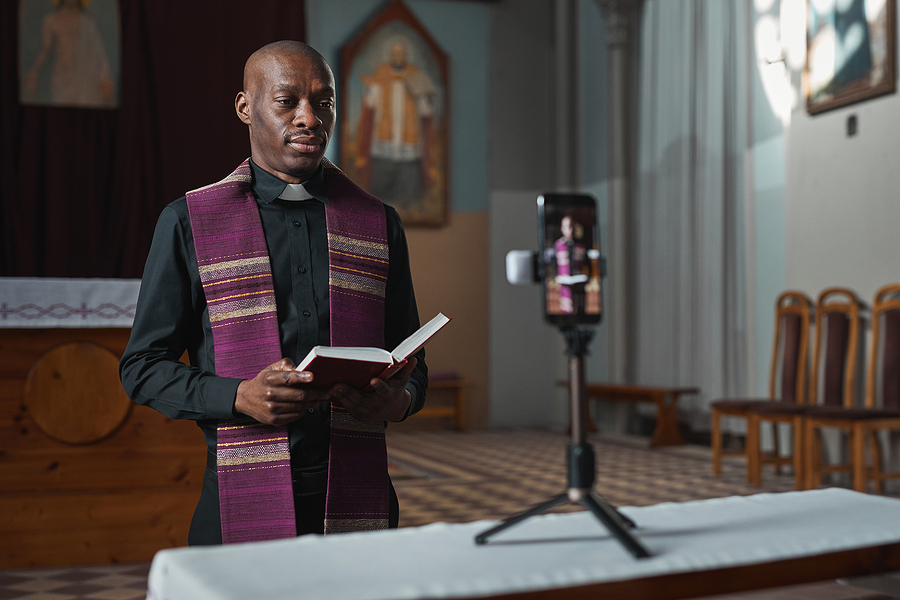
Make the move to bring your worship online.  You can do it with Facebook Live. That’s as simple as using a smartphone to capture what happens in worship.  When you do this, be sure to address the people who are watching, worshiping, and participating with you online.  Even if they watch later, they are still part of your congregation. Be sure to greet them. Include them in the message, the prayers, and the offering. Likely you’ll find your worship growing as you expand the ways people can participate.


Small Church Technology Do’s and Don’ts

Do make progress. You can go farther than you think you can. By incorporating technology and the accepting the learning curve that comes with it, you may be surprised how quickly you learn how to use the tools that are most helpful and necessary for your congregation.

Don’t assume that older people don’t want to embrace technology.  Many of them are meeting with kids and grandkids on weekly Zoom meetings, FaceTime visits, and the like. Also, don’t assume that every young person is constantly on their smartphone, or even has a smartphone.

Do use the technology you invest in for multiple purposes. A webcam is a great tool that can be used to record, livestream, or take worship to Zoom. This will allow greater participation for members that aren’t comfortable returning to church or can’t attend in person every week.

Don’t make tech decisions based solely on cost. Money that goes toward getting or upgrading outdated technology is money well spent. The benefits of buying quality equipment that will allow you to reach a larger community is unmatched.

Think of embracing technology as a journey, not an event.  Technology isn’t going away.  You can’t master it.  None of us can. But you also don’t have to resist the flow of it.

When it comes to technology, the point isn’t to be trendy.  Rather it’s to be connected in all the ways that are possible.  Just as the Bible reminds us that even feet can be beautiful as they carry the good news, so too can new technologies. They enable us to carry good news in fresh ways.

Not sure how to handle the technology reformation or other ways of moving people forward? Reach out here to stay connected. You don’t have to do it alone.


Copyright © 2021 rebekahsimonpeter.com, All Rights Reserved.

The 5 P’s of Sustainability for Small Churches

The 5 P’s of Sustainability for Small Churches

Small churches are the heartbeat of their communities and neighborhoods. The oft-preferred site of weddings and funerals, they offer spiritual community and support to people in transition. They are extremely important institutions in small towns—as essential as the gas station, grocery store, bank, hospital, and post office.

But small churches have an inherent problem.  They are small.  The question is, how do you know when your small church is sustainable, or if it’s time to call it quits? In this article I will reveal the 5 P’s of small church sustainability. Plus a word of encouragement if you want to learn more.


Small Church Problems

The pandemic has been particularly challenging for small churches, because the needs they fill have been in greater demand than ever, even as resources have been similarly pinched. In many cases, small churches have become even smaller.  Have they reached the tipping point where it’s too late for them to be sustainable?


The Most Dangerous Myth for Small Church Sustainability

Before I share the 5 P’s of small church sustainability, I need to warn you about one myth.  This myth, if you fall prey to it, can be the deal breaker for congregational sustainability.  This is the myth that in order to be sustainable, small churches have to be all things to all people. This idea is based on the megachurch model that one congregation can provide programming for every life stage, while addressing every physical, social, and spiritual need.

This myth is not only wrong it is dangerously wrong.

When small churches emulate the megachurch model, they set themselves up for failure. It’s almost physically impossible for small churches to meet every need of each life stage. Especially if their back-to-church numbers are smaller than their pre-pandemic numbers. The key to small church sustainability is to make sure you have the 5 P’s of sustainability in place. Then, to choose a few things to do well.


Small Churches Fight to Stay Alive

Ever since the industrial revolution of the 1800s, not to mention the Walmart revolution that put mom and pop stores out of business in the 1990’s, small communities have been economically challenged, making it harder than ever for small churches to survive and thrive.

I’ve been studying this phenomenon for the last 25 years.  While small towns are now making a comeback, churches have to be careful about how they position themselves to best serve their communities.

In my work with Creating a Culture of Renewal participants I have worked with pastors of churches as small as 6, and as large as 600. Most of our congregations tend toward the smaller in size. Through our work with church leaders, I have compiled the 5 P’s of small church sustainability.

circle of praying hands

The 5 P’s of Small Church Sustainability

People

The most important feature of a small congregation is its people. There are three factors to consider when evaluating how many people make for a sustainable congregation. First, churches with less than twenty committed members or participants will have a hard time staying afloat or being in ministry to others. Second, congregations need at least three generations—not counting the pastor and the parsonage family—to be sustainable. Third, consider the culture of the people.  Are people closed off or caring?

Prayer

After people, the second most important factor is prayer. Without a spiritual foundation, your church is not sustainable, no matter the size or the budget. In addition to a prayer chain, do you begin meetings with prayer, pray for guidance during decision-making time, and then follow the guidance? Prayer is the key to cooperation with God, as well as to sorting through the many choices that are before you. Your congregation must be firmly grounded in prayer to succeed.

Provision

Sustainable small churches support themselves financially. Often through a combination of tithing, memorial gifts, endowments, special funds, and fundraisers. Beware a few pitfalls.  First, big givers should contribute no more than 25% of the congregation’s budget for long-term sustainability. Your large givers will eventually move or die.  Second, endowments should not fund more than 25% of the church budget. Endowments relieve the urgency for attenders to become givers, or to give sacrificially.  Third, don’t rely on in-person giving only; this dynamic undermines sustainability. Instead encourage people to set up automatic withdrawals to the church or other forms of online giving.

Partnerships

Churches with people, prayer, and provision need to form community partnerships to ensure sustainability. As you transition out of the pandemic, create ways for your building to become multi-use. Some common ways are to rent space to a pre-school, a local non-profit, and/or one or more 12-step groups. But first, don’t forget to clean out the closets, re-configure storage space, and let go of items that have fallen out of use.  This will create more space for your partners.

Presence

Now that you have people, prayer, provision and partnership, it’s time to amplify your community presence.  Establish and keep up a Facebook page as well as a website. But if the website can’t be maintained, better not to have it.  Don’t forget small town newspapers, radio stations, and grocery store bulletin boards. The more you show up in the community, the more people will know where to turn when they need you.


Is Your Small Church Sustainable?

Now that you’ve evaluated your congregation on the 5 P’s of Small Church Sustainability, take heart. No matter your score, cultivating sustainability is an ongoing process. Learn how to develop your ability to grow and thrive through Creating a Culture of Renewal.


Copyright © 2021 rebekahsimonpeter.com, All Rights Reserved.

Small Church Worship and Education During the Pandemic

Small Church Worship and Education During the Pandemic

Small churches adopted a handful of models to survive the pandemic.  They include the church at home model, the shut-in model, the never shut down model, and the hybrid model. With these models come new opportunities to adapt worship and Christian education for your settings. In this article, I’ll share effective tips for how to keep worship alive and Christian education vibrant during the pandemic in your congregation.

You Are Not Alone

Small churches are often isolated from each other, so you may not be aware of how other congregations are coping.  The first thing I want you to know is that you are not alone. Through my work with congregations in Creating a Culture of Renewal®, we have gained wisdom from small churches around the country who are effectively using the following four models.


The Challenge: Effective Ways for Small Churches to Communicate Change

Whatever model you are using, there is one challenge that you must avoid.  This is the tendency of many churches to UNDER-communicate.  Churches that under-communicate assume that everyone already knows what is happening.  This dangerous assumption ensures that you will leave people out as you make changes. When you lose contact with your congregation, you weaken the bonds that will bring people back when it’s safe. Instead, regular communication allows you to stay connected with your people, and to implement the worship and Christian education tips I am about to share.

couple reading letters

How Small Churches Worship During the Pandemic

Here are the models we have found small churches using.

The Church at Home Model

The church at home model is similar to a home-school model and is especially useful if your church is shut down. Here, worship and Christian education is provided at home in a family setting. In a way, this is the ultimate small church. The value of families worshiping together cannot be underestimated.

Small churches can minister to the “church at home” by delivering weekly or monthly handouts that follow lectionary or seasonal themes. Coordinate worship and Christian education materials so they build on each other.  Several outlets such as Cokesbury provide free downloadables for just this purpose. The Upper Room or other subscription-based devotionals can fill in the gaps. Be sure to include an offering envelope, as well as letters of communication, if email is not being used.


The Shut-In Model

If your congregation has re-opened but older members are reluctant to return to in-person worship, consider the shut-in model.  Similar to the Church at Home Model, the Shut-In Model is delivery-based.

Just as you ministered to shut-ins before the pandemic, deliver bulletins, Upper Rooms, and pre-packaged consecrated Holy Communion to these folks. The one difference is the need to socially distance, and the potential reluctance to have non-family members enter the home. Be sure to include newsletters, and an offering envelope, in your delivery.

If internet is not available in your setting, both the Church at Home and Shut-In models can benefit from a conference call number.  This could be used for bridge-line-based prayer, worship, and brief Christian education sessions.


Never Shut Down Model

Congregations that never stopped meeting or continued to meet for the most part will want to pay special attention to protecting at risk populations. This includes folks who are unvaccinated.  Be sure to ask people to mask, to sit 6 or more feet apart during worship, and to use hand sanitizer. The value of meeting together, even under these conditions, cannot be over emphasized.  People to people contact, worshiping in community, and the joy of seeing familiar faces—while keeping safety practices in place—boosts the spirit and makes glad the heart.


Hybrid Model

If and when your small church begins to meet again, don’t be surprised if some of your people don’t return. They may opt out, either because of safety concerns or because they just got out of the habit. In this case, developing a hybrid model of worship and education may be your best bet. If internet is not accessible, your hybrid model would be ongoing delivery to the church at home or to the shut-in folks even as the rest of your congregation worships in person. Again, be sure to mail offering envelopes or give people an opportunity to give online. If you have internet access, use that to create a hybrid community that allows for people to participate online or in person. You can livestream worship and Bible Study on Facebook or record and post to YouTube.


It’s time now to plan your next outreach, whether a mailbox delivery for Thanksgiving, a bulletin, or a letter to your congregation. Lead with love, follow up with invitation, and round it out with a call to action.  Ask people to pray for one another, to contribute to a food bank, or to call their neighbor. Just because folks aren’t meeting in person, doesn’t mean they can’t stay connected. Also, don’t forget to ask them to contribute to the work of the church. Finally, if you are looking for the next best practice as you survive the pandemic,  join me for a brand new online short course starting in November: Church Growth: From Barriers to Breakthroughs.


Copyright © 2021 rebekahsimonpeter.com, All Rights Reserved.

Three Big Skills Every Small-Town Pastor Needs to Know

Three Big Skills Every Small-Town Pastor Needs to Know

Ministry in small towns and rural settings requires a special skill set. The congregations tend to be family-sized congregations with a long history but a shrinking impact.  At the same time, the role they occupy in the community is more important than ever.  Especially throughout the pandemic.

In this article I will zero in on three big skills every small-town pastor needs to know plus the #1 trap you must avoid in order to be effective.

The years I spent ministering in an isolated Wyoming community showed me the necessity of these skills.  More than that, their necessity has been confirmed through my work in Creating a Culture of Renewal® in which we serve small town, bi-vocational, and rural pastors (as well as urban and suburban pastors.)


Joys and Challenges of Small-Town Ministry

If you’re reading this article, likely you know that ministry in small towns and rural settings is both a joy and a challenge.

First, the joys: folks are committed to the life of the church; they don’t put on pretenses; and they are  resilient.

Next, the challenges. Smaller congregations have needs larger than their church size would indicate.  For instance, their communities have changed through economics, immigration, and age demographics. That means they are probably poorer, more diverse, and less able to reach out to young people and young families than they need to be. At the same time, their resilient congregational culture means they don’t easily change. Finally, they often can’t afford full-time ministers, so it’s harder for them to steer the congregation in a new direction. These hard-to-solve challenges can set you, the small-town pastor, up for a trap.


Avoid This Trap

I call this trap the give-more-time trap. This is the number one trap of part time and bi-vocational pastors. It’s based in the belief that if you really cared, or you were really called, that you would do it all: attend every meeting, event, community function and make every pastoral call possible; and that somehow through sheer force of will, you would be able to solve the community’s problems. Even if you’re part time. The other side of the trap is that if you don’t do it all, you are not a “good” pastor.

Both of these are lies.

Don’t fall prey to the give-more-time trap. Buying into it sets you up for over-work, resentment, burn out, and loss of faith. None of these are good outcomes. For you, the congregation, or the community. Forget about being a time-warper. Instead, focus on the following three big skills.


Three big skills small town pastors need

Three Big Skills

  1. Lead from the Middle

There are three positions from which to lead:  in front, from behind, and in the middle.  Leading from the front means you are generally moving faster than your people.  Leading from behind means you are either more risk-averse than they are, or slower paced than they are. Honestly, it’s hard to get buy-in when you lead from either of these positions; you are too disconnected from them. Instead, try leading from the middle.

To lead from the middle, find their natural pace of decision-making and speed up the pace one notch.  It’s like driving 5-7 miles over the speed limit. Leading from the middle also means working collaboratively rather than dominating or lagging behind. A great way to do this is to form a Bible study with your key leaders and decision-makers so you have natural points of additional contact with them throughout the week and month.

  1. Train and Empower

Because you can’t solve all the community’s problems—especially if you are part time or bi-vocational–you have to figure out the wisest way to use your time. A close study of the life of Jesus shows that even he didn’t try to do it all.  Instead, he used the bulk of his time to train and empower others. Remember how he sent out the 12 and the 72 ahead of him? By the time Jesus went to the cross, he had people who could carry on his ministry.  Emulate Jesus by training people to preach, teach, pray, exegete the scriptures, and lead meetings.  Then empower them to do so while you coach and encourage, disciple and mentor them.

  1. Be Community-Minded

In small towns and rural settings, the community is the congregation; and the congregation is the community.  When you show up at community events you demonstrate your love and leadership in tangible ways.  While you don’t have to serve on Rotary, volunteer to be the police chaplain, and attend all the hometown sports, do find ways to be present in the lives of the children and youth. In light of the pandemic, offering mental health and grief support may be the most effective way to serve your community at large. Remember, you may be the professional most equipped in your community to address these concerns.


Embrace the Joys and the Challenges

Every ministry has its own joys and challenges. The same will be true for you.  When you embrace the three big skills of small-town pastors, you’ll find more joy than challenge.  Have you identified another skill you would recommend?  Or not sure what your next step should be? Reach out for a one-on-one consultation and let’s talk.


Copyright © 2021 rebekahsimonpeter.com, All Rights Reserved.

Are You Playing Jeopardy with Your Church?

Are You Playing Jeopardy with Your Church?

Are You Playing Jeopardy with Your Church?

Have you been watching the drama unfolding in the search for Alex Trebek’s replacement on the game show Jeopardy!? For a low-drama show, their blunders have captured outsized attention. The question church decision-makers need to answer is “Are you playing jeopardy with the future of your church?”

Read on to learn from both their slip ups and successes so that you don’t have to jeopardize the future of your church.


Avoid Unintentional Interims

After Alex Trebek died, the show wisely planned a series of guest hosts before naming a permanent replacement. Trebek captured America’s heart for 36 seasons, leaving gigantic shoes to fill after he passed. If the producers had installed a permanent host directly after Trebek’s death, that host would have been an unintentional interim. Instead, the producers arranged for a line-up of 16 celebrities and personalities who hosted the show for one or two weeks each.

Congregations, like Jeopardy! need intentional interim leaders. Once a notable pastor, whether beloved or controversial, steps down, the church needs time to mourn, re-group, and re-orient before accepting a new leader.  Churches can’t do this work without a proper period of grieving, letting go, and preparing for new directions.  When churches don’t appoint an intentional interim, they often wind up with an unintentional interim. Unintentional interims jeopardize a church’s future because they disrupt momentum, discourage members with failed leadership, and delay opportunities for growth.


Vet Your Leaders

If you’ve been following the Jeopardy! news (mine shows up in my phone’s feed so I don’t have to look far) you know that Mike Richards, the show’s executive producer, was named by Sony as Alex Trebek’s successor. Sony studied tapes of Mike Richards interacting with contestants and tested his appeal with focus groups.  While they were busy studying his overall appeal, they missed vetting his past.  Therein lies the problem. Richards’ past was peppered with a history of discriminatory behavior against women on other shows where he was an executive producer. Then his podcast past caught up with him where he recorded tasteless, sexist jokes. All that makes Richards a no-go.

Likewise, churches need to vet their leaders—both lay and clergy.  How many churches, even whole denominations, have been hurt when inappropriate leaders have proceeded to cause havoc because of undisclosed sexual or financial misconduct, or other forms of hurting the very organizations they are called to lead? We have only to think of the cover ups of the Catholic and Southern Baptist churches, amongst others, to know that leaders who prey on their followers are bad news indeed. If you are promoting unvetted leaders, you are putting the future of your church in jeopardy.  Don’t do it.


Read the Culture Right

Leaders exemplify the culture. That’s why Dr. Mehmet Oz was a problem as a guest host. While he had a great personality and was good with the contestants, his medical reputation was tainted by the suspect advice he dispensed and unproven products he sold. Jeopardy! fans cried foul and asked for his removal.

Most troubles occur when a leader tries to quickly change the culture, without building enough trust or connecting the dots between past and present.  In the end, Big Bang actor Mayim Bialik, a Ph.D neuroscientist, and Ken Jennings, a winning Jeopardy! champion, will take over the helm. For now. Jennings had social media gaffes as well. He may not make the final cut. Producers will not only capitalize on the show’s current culture, but expand it by having a highly educated funnywoman who also happens to be an ethnic minority.

In the church, each leader is seen—fairly or unfairly—as a representative of the congregation, of Jesus, and of Christianity as a whole. You need to not only vet the leaders, but make sure they are the kind of public representative that reflects the Gospel well. Make sure that their personal life is beyond reproach. If it’s not, get them some help bringing their personal and public lives into sync. Otherwise, you are putting the future of your church in jeopardy!

Have a specific question about how to avoid putting your congregation or ministry in jeopardy? Contact me for a free consultation.


Copyright © 2021 rebekahsimonpeter.com, All Rights Reserved.